AI vs Automation – Key Differences, Benefits & Use Cases in 2026
Discover the key differences between AI vs Automation, how they work, their benefits, and which is better for businesses in 2026. Learn how AI and automation improve productivity and SEO.
AI vs Automation: Understanding the Real Difference
Technology is evolving rapidly, and businesses are constantly looking for ways to improve efficiency and productivity. Two terms that often appear in discussions about digital transformation are Artificial Intelligence (AI) and Automation. While many people use these terms interchangeably, they are actually different technologies with unique capabilities.
Understanding AI vs Automation is essential for businesses, marketers, and website owners who want to stay competitive in the digital era. Both technologies help reduce manual work, improve efficiency, and streamline processes, but they work in very different ways.
In simple terms, automation follows predefined rules, while AI can learn, analyze, and make decisions based on data.
This guide will explain the difference between AI and automation, their benefits, real-world examples, and how businesses can use them effectively in 2026.
What is Automation?
Automation refers to the use of technology to perform tasks automatically without human intervention. It works based on predefined rules and instructions.
Automation systems follow a set workflow. Once the rules are programmed, the system repeats the same tasks consistently.
Common Examples of Automation
Some everyday examples of automation include:
- Email marketing automation
- Scheduled social media posting
- Automated backups
- Customer support chatbots with preset responses
- Data entry automation
- Automated SEO reports
For example, when a blogger schedules posts or automatically shares articles on social media, that is automation in action.
Businesses also use automation in digital marketing. Tools can automatically publish content, track rankings, and generate reports.
You can learn more about practical SEO automation techniques in SEO Automation Guide which explains how automation can simplify search engine optimization tasks.
What is Artificial Intelligence (AI)?
Artificial Intelligence is a more advanced technology that allows machines to simulate human intelligence.
Unlike automation, AI systems can:
- Learn from data
- Recognize patterns
- Make predictions
- Adapt to new situations
AI uses technologies like machine learning, natural language processing, and deep learning to improve over time.
Examples of Artificial Intelligence
AI is widely used in many modern technologies, including:
- Voice assistants like Siri or Alexa
- AI chatbots
- Personalized product recommendations
- AI content generation tools
- Image recognition systems
- Fraud detection systems
For example, Netflix recommending movies based on your watch history is powered by AI.
According to IBM’s guide to Artificial Intelligence, AI enables machines to analyze large amounts of data and make intelligent decisions faster than humans.
Key Differences Between AI and Automation
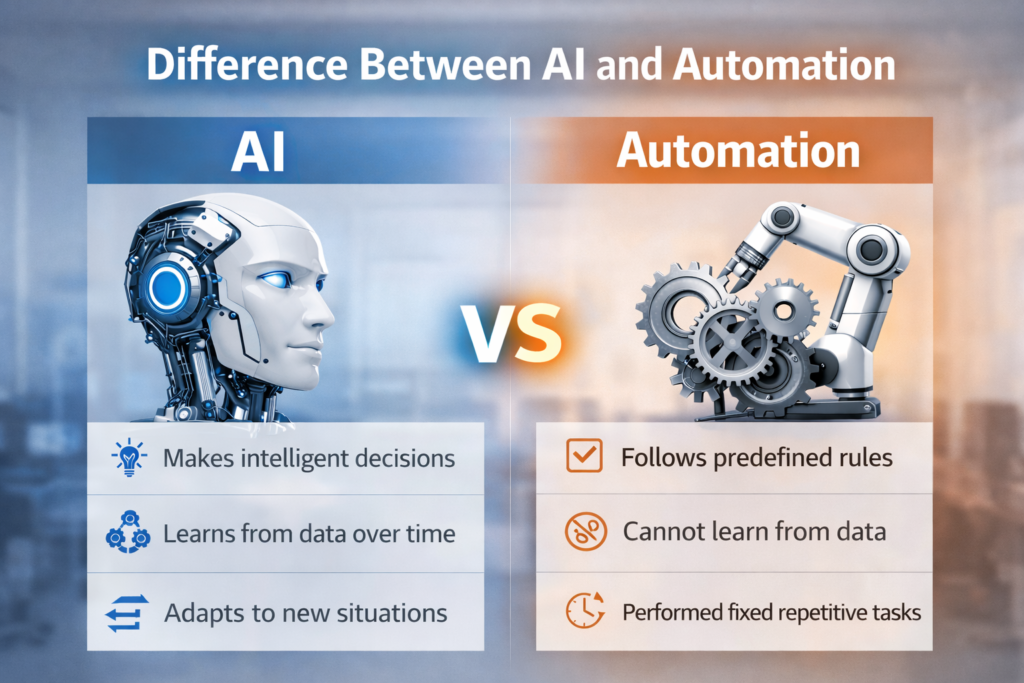
Although AI and automation are closely related, there are several important differences.
Decision Making Ability
Automation follows strict rules and instructions.
AI, on the other hand, can analyze data and make intelligent decisions based on patterns.
For example:
- Automation: Sends an email when someone subscribes.
- AI: Analyzes user behavior and sends personalized emails.
Learning Capability
Automation systems do not learn from experience.
AI systems can learn from data and improve over time.
This means AI can become smarter and more accurate as it processes more information.
Complexity of Tasks
Automation works best for simple, repetitive tasks.
AI can handle complex tasks that require analysis and decision-making.
Examples include:
Automation tasks:
- Scheduling posts
- Data backups
- Sending automated emails
AI tasks:
- Predicting customer behavior
- Image recognition
- Advanced data analysis
Flexibility
Automation systems are limited to the rules programmed into them.
AI systems are more flexible because they can adapt to new data and changing situations.
Benefits of Automation
Automation offers several advantages for businesses and digital marketers.
1. Saves Time
Automation reduces the time spent on repetitive tasks such as scheduling posts, generating reports, and managing workflows.
2. Reduces Human Errors
Manual tasks often lead to mistakes. Automation performs tasks consistently and accurately.
3. Improves Productivity
By automating routine work, teams can focus on important strategic tasks.
4. Cost Efficiency
Automation reduces the need for large teams to perform repetitive work.
For bloggers and marketers, automation tools can significantly improve productivity. For example, SEO Automation Services for Bloggers help automate keyword tracking, content optimization, and reporting.
Benefits of Artificial Intelligence
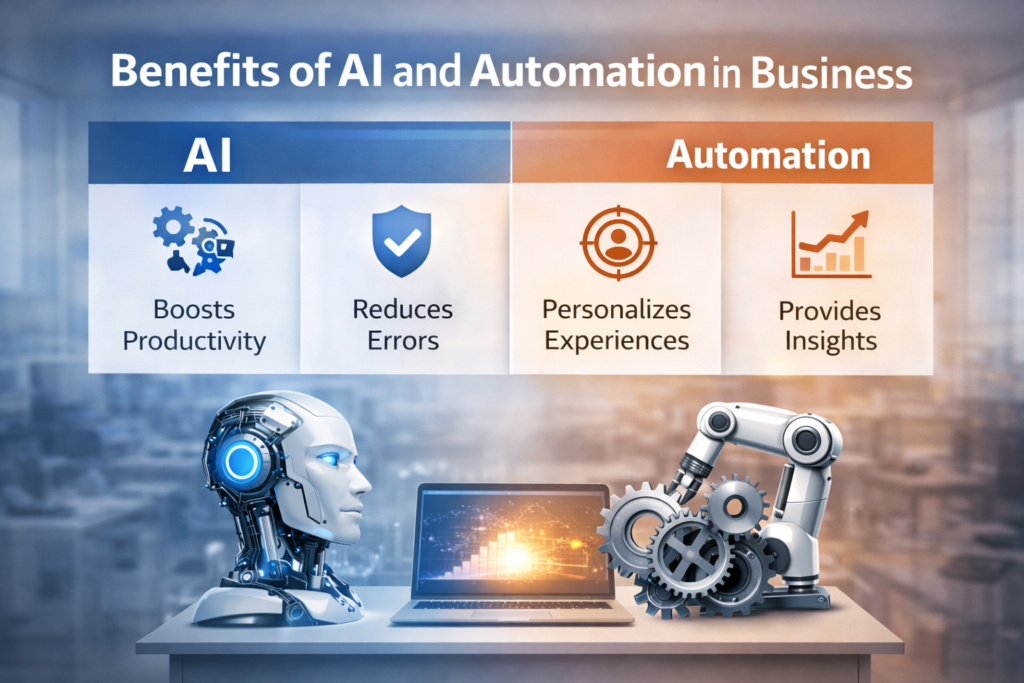
AI provides more advanced capabilities compared to traditional automation.
Intelligent Decision Making
AI analyzes massive datasets to make better and faster decisions.
Personalization
AI helps businesses create personalized experiences for users.
Examples include:
- Personalized search results
- Product recommendations
- Targeted advertisements
Predictive Analytics
AI can analyze past data to predict future trends.
Businesses use predictive analytics for:
- Sales forecasting
- Customer behavior analysis
- Market trend prediction
Advanced Problem Solving
AI systems can solve complex problems that traditional automation cannot handle.
This makes AI extremely valuable in industries like healthcare, finance, and digital marketing.
AI vs Automation: Which One is Better?
The answer depends on the type of task.
Automation is Best For
- Repetitive tasks
- Simple workflows
- Rule-based processes
AI is Best For
- Data analysis
- Decision making
- Predictive insights
- Personalization
In reality, the best solution is often combining AI with automation.
Many modern tools now use AI-powered automation, which means automation workflows enhanced with AI intelligence.
How AI and Automation Are Transforming SEO
SEO is one of the industries that benefits the most from AI and automation.
Automation in SEO
Automation tools help with:
- Rank tracking
- Keyword monitoring
- Site audits
- Backlink monitoring
- Scheduled reports
AI in SEO
AI tools assist with:
- Keyword research
- Content optimization
- Search intent analysis
- Content generation
- Competitor analysis
By combining AI and automation, SEO professionals can significantly improve efficiency and results.
Future of AI and Automation in 2026 and Beyond
The future of technology will involve deeper integration of AI and automation.
Experts predict that businesses will increasingly rely on AI-powered automation systems that can:
- Analyze data automatically
- Make intelligent decisions
- Optimize workflows in real time
Industries such as digital marketing, healthcare, finance, and e-commerce will benefit the most.
Companies that adopt AI and automation early will gain a major competitive advantage.
Conclusion
Understanding the difference between AI vs Automation is crucial in today’s technology-driven world.
Automation focuses on repetitive rule-based tasks, while AI focuses on learning, analysis, and intelligent decision making.
Both technologies offer significant benefits for businesses, especially when combined together.
Automation improves efficiency and productivity, while AI provides powerful insights and smarter decision-making.
As technology continues to evolve, businesses that leverage AI and automation together will be better positioned for growth, innovation, and long-term success.
Frequently Asked Questions (FAQ)
What is the main difference between AI and automation?
The main difference is that automation follows predefined rules, while AI can learn from data and make intelligent decisions.
Can automation work without AI?
Yes. Automation can work independently using rule-based systems without AI.
Is AI better than automation?
AI is more advanced, but it is not always better. Automation is ideal for repetitive tasks, while AI is best for complex decision-making processes.
How are AI and automation used in SEO?
AI helps with keyword research, content optimization, and search intent analysis, while automation helps manage repetitive tasks like rank tracking, reporting, and scheduling.
Can AI replace automation?
AI will not completely replace automation. Instead, most modern systems combine both technologies to create smarter automated workflows.