Types of Artificial Intelligence with Real Life Examples – Complete Guide
Learn the main types of Artificial Intelligence with real life examples. Discover how reactive machines, limited memory, theory of mind, and self-aware AI work in everyday life.
Types of Artificial Intelligence with Real Life Examples
Artificial Intelligence (AI) is transforming the way businesses, technology, and everyday systems operate. From voice assistants to self-driving cars, AI has become a crucial part of modern digital infrastructure. Understanding the types of artificial intelligence with real life examples helps people see how AI works and where it is heading in the future.
AI can be categorized in different ways, but the most common classification is based on capability and functionality. These categories explain how intelligent a system is and how it interacts with data and humans.
In this guide, we will explore the main types of AI, how they work, and where they are used in real life.
What is Artificial Intelligence?
Artificial Intelligence refers to machines or computer systems that can perform tasks that normally require human intelligence. These tasks include:
- Learning from data
- Recognizing speech
- Making decisions
- Solving complex problems
- Understanding natural language
AI systems rely on technologies such as machine learning, neural networks, and data analytics to function.
If you want to understand advanced AI concepts, you can also read Artificial General Intelligence Explained for deeper insights into the future of intelligent machines.
According to Artificial Intelligence explained by IBM, AI uses algorithms and large datasets to simulate human intelligence and improve decision-making processes.
Main Types of Artificial Intelligence
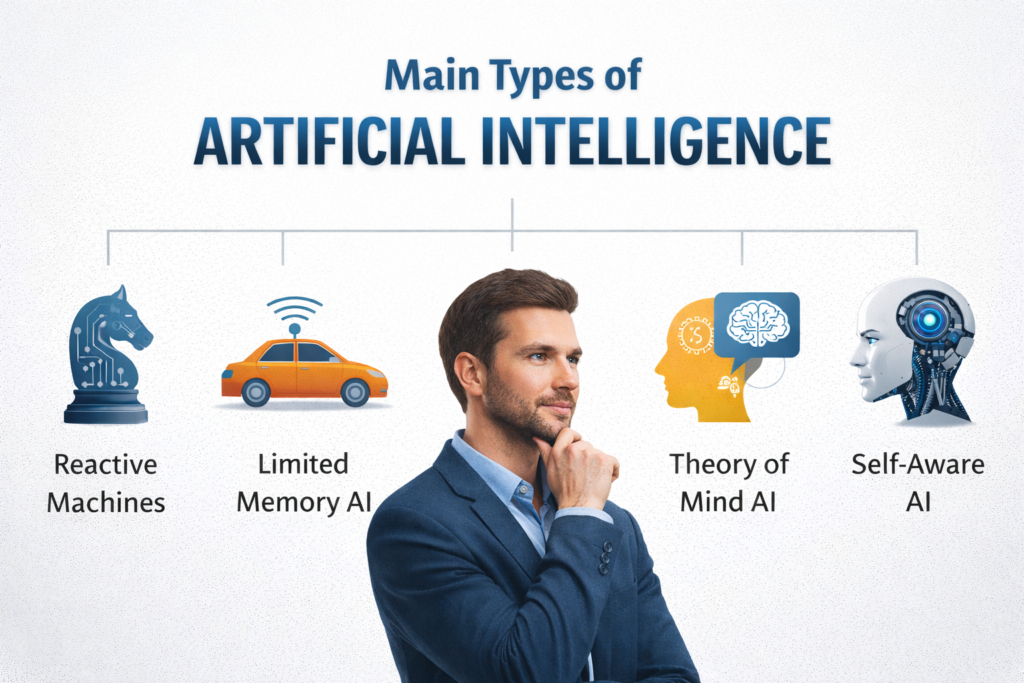
Artificial Intelligence is commonly divided into four major types based on functionality. Each type represents a different level of intelligence and capability.
These include:
- Reactive Machines
- Limited Memory AI
- Theory of Mind AI
- Self-Aware AI
Let’s explore each of them in detail with real-life examples.
Reactive Machines
Reactive machines are the most basic type of artificial intelligence. These systems do not store past experiences or learn from previous data. They simply react to current inputs and produce outputs.
Reactive AI follows predefined rules and cannot improve itself over time.
Key Characteristics
- No memory of past events
- Cannot learn from experience
- Works only with present data
- Very task-specific
Real Life Examples
Chess Playing AI
One of the most famous examples is IBM’s Deep Blue, which defeated world chess champion Garry Kasparov in 1997. The system analyzed millions of moves but did not learn from past games.
Spam Filters
Basic spam detection systems identify suspicious patterns in emails and block them automatically.
Recommendation Engines (Simple Models)
Some simple recommendation systems analyze immediate behavior but do not store historical learning.
Reactive machines are limited but still useful for specific rule-based tasks.
Limited Memory AI
Limited Memory AI is the most widely used type of artificial intelligence today. These systems can learn from past data and improve their performance over time.
They store historical information for a limited period and use it to make better decisions.
Key Characteristics
- Uses past data for learning
- Improves accuracy over time
- Common in machine learning systems
- Used in real-world applications
Real Life Examples
Self-Driving Cars
Autonomous vehicles analyze traffic data, road conditions, and nearby vehicles to make decisions. They constantly learn from previous driving data.
Voice Assistants
Digital assistants like voice-activated AI systems use previous interactions to understand commands more accurately.
Streaming Recommendations
Platforms like video streaming services analyze your watch history to recommend new content.
Fraud Detection Systems
Banks use AI models to analyze past transaction patterns and detect suspicious activities.
Most modern AI applications today fall into the limited memory category because they rely on machine learning models trained on large datasets.
For a deeper explanation of AI categories, you can also explore 3 Types of AI Explained.
Theory of Mind AI
Theory of Mind AI is a more advanced and experimental form of artificial intelligence. It focuses on creating machines that understand human emotions, beliefs, and intentions.
This type of AI is still under development and has not yet been fully implemented.
Key Characteristics
- Understands human emotions
- Recognizes behavior patterns
- Can interpret intentions
- Interacts socially with humans
Potential Real Life Applications
Emotional AI Assistants
Future virtual assistants could detect emotions in human voices and respond accordingly.
Healthcare Robots
Robots in hospitals could analyze patient emotions and provide emotional support.
Smart Customer Support
AI systems may detect frustration in customer conversations and adjust responses accordingly.
Although this technology is still in development, it represents the next stage of human-AI interaction.
Self-Aware AI
Self-aware AI is the most advanced and theoretical type of artificial intelligence. These machines would have their own consciousness and awareness similar to humans.
Currently, this type of AI does not exist, but it is often discussed in research and science fiction.
Key Characteristics
- Consciousness and self-awareness
- Independent decision-making
- Emotional understanding
- Ability to form thoughts and opinions
Possible Future Examples
Autonomous AI Systems
Machines that operate completely independently without human control.
Advanced Personal AI Assistants
Assistants capable of understanding emotions, preferences, and human behavior deeply.
Intelligent Robots
Robots that can think, learn, and adapt like humans.
Although self-aware AI is still theoretical, it represents the ultimate goal of AI research.
Why Understanding AI Types is Important
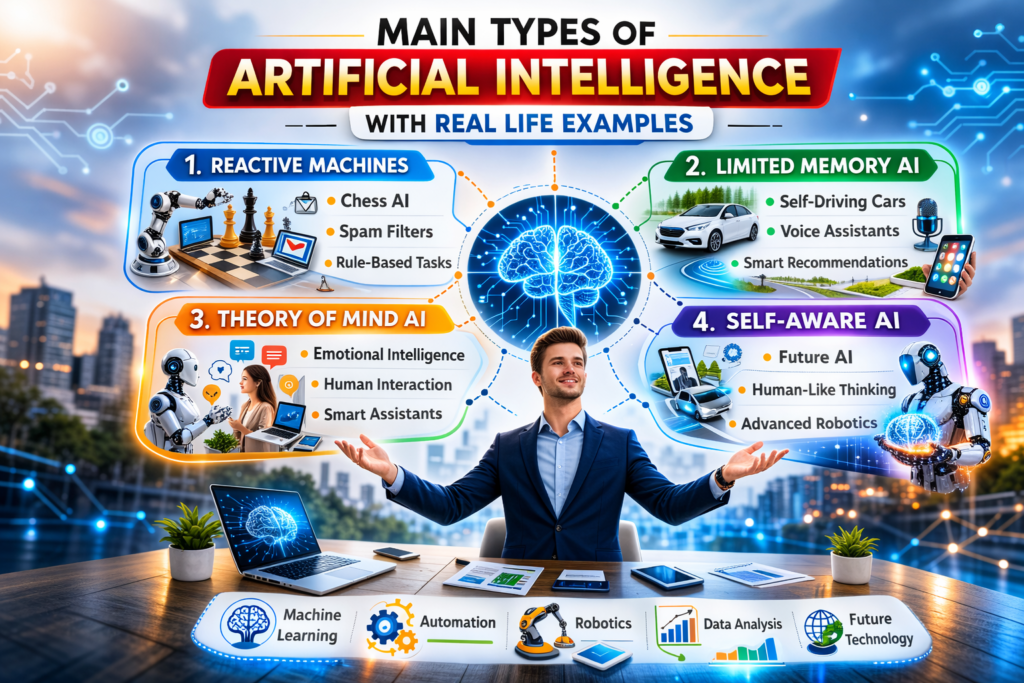
Learning about the types of artificial intelligence with real life examples helps individuals and businesses understand how AI technologies impact different industries.
Here are some key benefits:
Better Technology Awareness
Understanding AI helps people adapt to technological advancements.
Business Innovation
Companies can use AI tools to automate processes and improve efficiency.
Career Opportunities
AI knowledge opens doors to careers in data science, machine learning, and automation.
Improved Decision Making
Organizations use AI insights to make data-driven decisions.
Future of Artificial Intelligence
Artificial Intelligence is evolving rapidly. Researchers are constantly working to develop smarter and more efficient systems.
Future AI trends may include:
- More advanced automation
- Human-like AI assistants
- AI-powered healthcare solutions
- Intelligent robotics
- Ethical AI development
As AI continues to grow, understanding its different types will become even more important.
Conclusion
Artificial Intelligence is revolutionizing industries across the world. By understanding the types of artificial intelligence with real life examples, we can better appreciate how this technology works and where it is heading.
The four main types of AI include:
- Reactive Machines
- Limited Memory AI
- Theory of Mind AI
- Self-Aware AI
While the first two types already power many modern applications, the last two represent the future of intelligent technology.
As AI continues to advance, it will reshape industries, improve efficiency, and create new opportunities for innovation.
Frequently Asked Questions (FAQs)
What are the 4 types of artificial intelligence?
The four main types of AI are:
- Reactive Machines
- Limited Memory AI
- Theory of Mind AI
- Self-Aware AI
These categories represent increasing levels of intelligence and capability.
What is an example of reactive AI?
A famous example is IBM Deep Blue, a chess-playing AI system that defeated a world champion by analyzing possible moves without learning from past experiences.
Does self-aware AI exist today?
No, self-aware AI does not exist yet. It is still a theoretical concept discussed in advanced AI research.
Why is AI important in real life?
AI helps automate tasks, analyze large datasets, improve decision-making, and enhance services in industries like healthcare, finance, marketing, and transportation.