How do teachers check for AI in student assignments? Learn the tools, methods, and signs educators use to detect AI-generated content in 2025.
How Do Teachers Check for AI in Student Assignments?
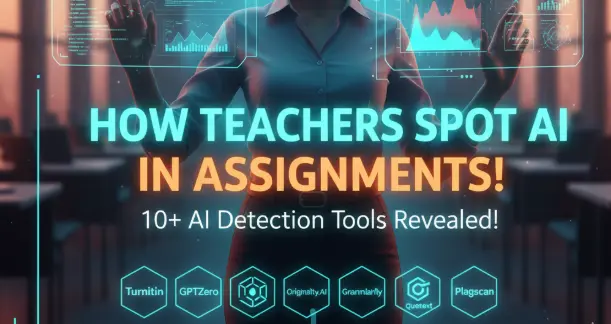
With the rapid rise of artificial intelligence tools like ChatGPT, students are increasingly using AI to help with homework, essays, and projects. This has raised an important question in education: how do teachers check for AI-generated content?
In 2025, teachers are more aware, better trained, and equipped with advanced tools to identify AI-written work. This article explains all the methods teachers use, the tools involved, and how students can use AI responsibly without getting into trouble.
Why Are Teachers Concerned About AI Use?
Teachers are not against technology. In fact, many educators actively use AI for lesson planning and grading. However, the concern arises when students submit AI-generated content as their own original work.
Key reasons teachers monitor AI usage include:
- Academic dishonesty
- Lack of critical thinking
- Reduced learning effort
- Unfair grading
To balance innovation and integrity, teachers now actively check assignments for AI involvement.
How Do Teachers Check for AI? Main Detection Methods
Teachers use a combination of tools and human judgment rather than relying on one single method.
AI Detection Tools
Many schools and universities use AI-detection software to scan assignments.
Common tools include:
- Turnitin AI Detection
- GPT detectors
- Integrated LMS AI scanners
These tools analyze:
- Sentence predictability
- Writing uniformity
- Probability-based language patterns
However, teachers know that AI detectors are not 100% accurate, so results are used as indicators, not final proof.
Writing Style Comparison
One of the most effective ways teachers check for AI is by comparing current work with past assignments.
Teachers look for:
- Sudden improvement in vocabulary
- Change in tone or structure
- Overly polished grammar
- Generic explanations without personal insight
If a student usually writes simple sentences and suddenly submits a highly professional essay, it raises suspicion.
Lack of Personal Examples
AI-generated content often:
- Lacks real-life experiences
- Avoids personal opinions
- Uses broad, neutral language
Teachers expect specific classroom references, local examples, or personal reflections, which AI struggles to provide naturally.
Oral Questioning and Follow-Ups
Teachers may ask students to:
- Explain their assignment verbally
- Defend arguments used in the paper
- Answer follow-up questions in class
If a student cannot explain what they submitted, teachers may conclude AI assistance was used improperly.
Can Teachers Really Prove AI Use?
This is a very important point.
Teachers usually cannot prove AI use with absolute certainty. Instead, they rely on:
- Multiple warning signs
- Tool results + behavior
- Institutional AI policies
Most schools now follow a review-based approach, not direct punishment without discussion.
Ethical Use of AI in Education
AI is not banned everywhere. In fact, many educators encourage ethical AI usage, such as:
- Brainstorming ideas
- Grammar checking
- Improving clarity
- Learning support
Teachers themselves use AI tools for lesson planning. You can explore how educators benefit from AI here:
AI Tools for Teachers: Transforming Education with Smart Technology in 2025
The key rule is transparency and originality.
External Perspective on AI Detection
According to education experts, AI detection should focus more on learning outcomes rather than punishment. Many global institutions are shifting towards AI literacy instead of strict bans.
A detailed discussion on academic integrity and AI can be found on Turnitin’s official resources which emphasize balanced AI policies.
How Students Can Avoid AI Detection Issues
Students can stay safe by:
- Using AI only for guidance
- Rewriting content in their own words
- Adding personal examples
- Understanding what they submit
- Following school AI policies
If you understand your assignment deeply, teachers will rarely question your work.
FAQs: How Do Teachers Check for AI?
Q1: Can teachers detect ChatGPT usage?
Teachers cannot directly see ChatGPT usage, but they can identify AI-like patterns using tools and writing analysis.
Q2: Are AI detectors accurate?
No detector is 100% accurate. Teachers use them as supporting tools, not final evidence.
Q3: Is using AI for homework illegal?
It depends on school policy. Some allow limited use, others require full originality.
Q4: Can paraphrasing avoid AI detection?
Paraphrasing alone does not guarantee safety. Teachers also look for understanding and consistency.
Q5: Will AI use always result in punishment?
Not always. Many teachers prefer discussion and guidance instead of penalties.
Final Thoughts
So, how do teachers check for AI in 2025?
The answer is simple: through smart tools, experience, and student interaction.
AI is transforming education, but honesty and learning remain the foundation. Students who use AI responsibly, understand their work, and follow guidelines have nothing to fear. Instead of asking how to hide AI usage, it’s better to learn how to use AI as a learning partner, not a shortcut.