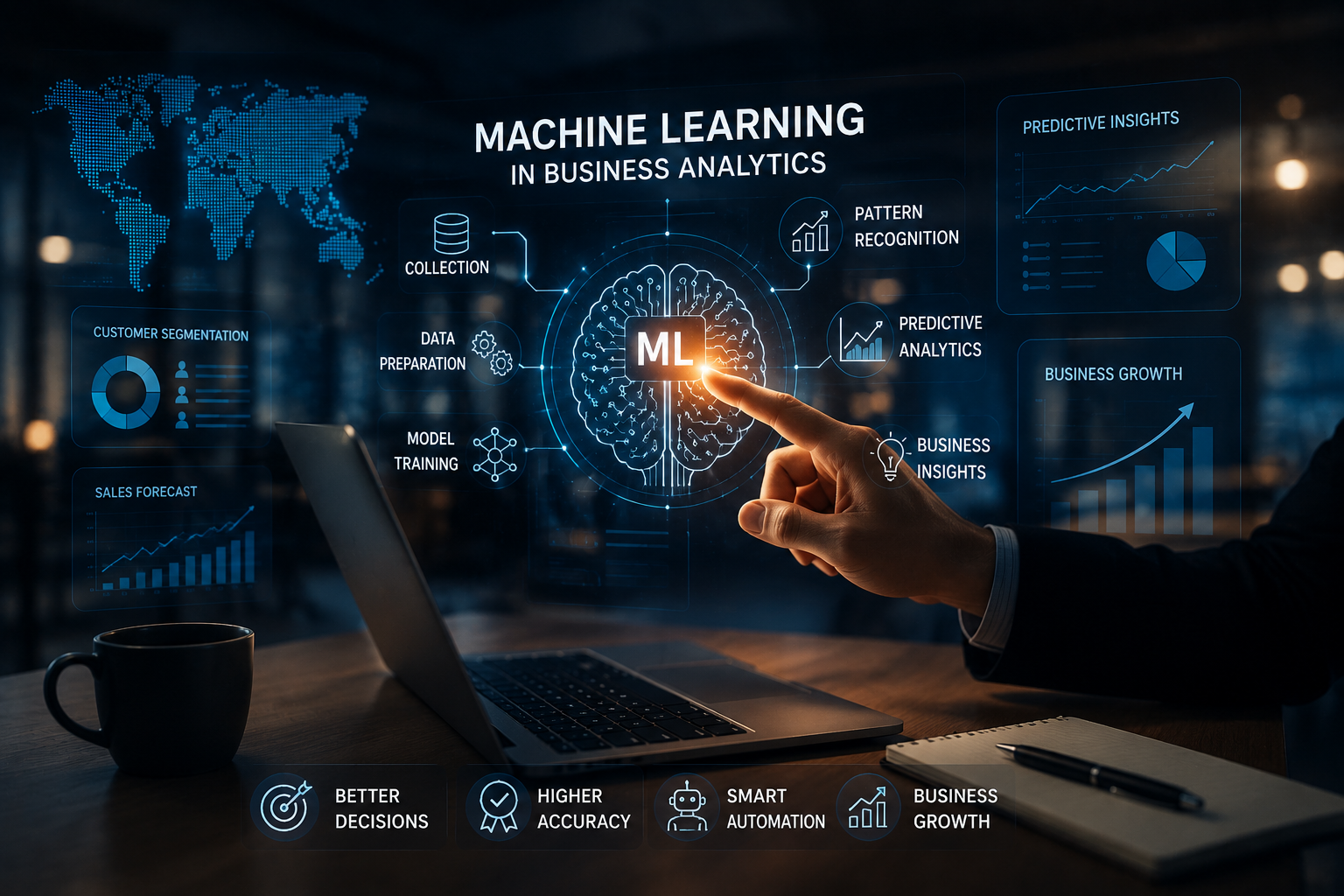
Learn how machine learning in business analytics helps companies improve decision-making, predict trends, automate insights, and drive business growth in 2026.
Introduction
Businesses today generate more data than ever before. Every customer interaction, website visit, transaction, and operational process creates valuable information. The challenge is not collecting data anymore — it is understanding what the data means and how it can support better business decisions.
This is where machine learning in business analytics becomes important.
In 2026, organizations increasingly use machine learning to analyze data faster, detect patterns, predict outcomes, and improve business performance. Instead of relying only on historical reports, companies now use intelligent systems that learn from data and continuously improve over time.
Machine learning helps businesses move from reactive decisions to predictive and strategic planning. It enables teams to discover opportunities, reduce inefficiencies, and respond to changing market conditions more effectively.
What Is Machine Learning in Business Analytics?
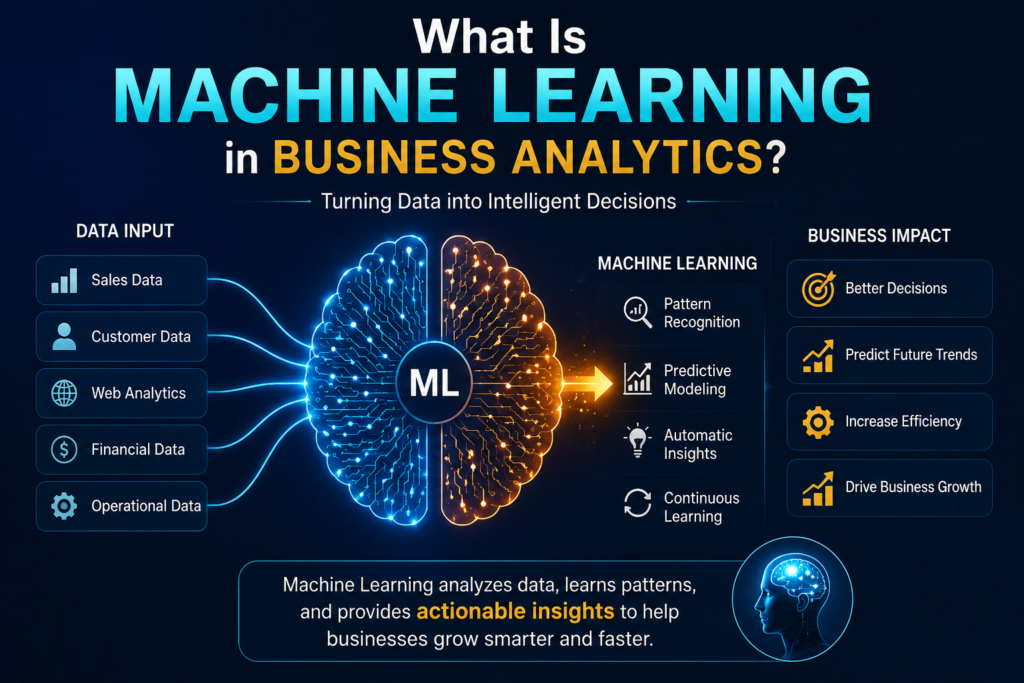
Machine learning in business analytics refers to the use of algorithms that learn from data and identify patterns without being explicitly programmed for every task.
In business environments, machine learning systems process large amounts of structured and unstructured data to generate insights, predictions, and recommendations.
Unlike traditional analysis, which often depends on manual reporting and historical interpretation, machine learning can detect hidden relationships, forecast future outcomes, and adapt as new information becomes available.
To understand the broader foundation of AI-driven business strategy, explore Artificial Intelligence Business Analysis 2026
Why Machine Learning Matters in Modern Business
Modern businesses operate in competitive and rapidly changing markets. Decision-making based only on intuition or historical reports is often too slow.
Machine learning helps organizations by:
- processing large datasets quickly
- identifying patterns humans may miss
- improving forecasting accuracy
- supporting faster strategic decisions
- reducing repetitive manual analysis
This allows businesses to respond faster to customer behavior, market changes, and operational challenges.
How Machine Learning Works in Business Analytics
Machine learning systems usually follow a simple process.
Data Collection
Businesses collect data from multiple sources such as websites, sales platforms, customer interactions, financial reports, and internal systems.
Pattern Recognition
Algorithms analyze the data to identify trends, relationships, and recurring behavior.
Prediction
Based on historical and current information, machine learning models predict future outcomes.
Continuous Improvement
As new data enters the system, the model becomes smarter and more accurate over time.
This learning cycle makes machine learning highly valuable for business analytics.
Common Applications of Machine Learning in Business Analytics
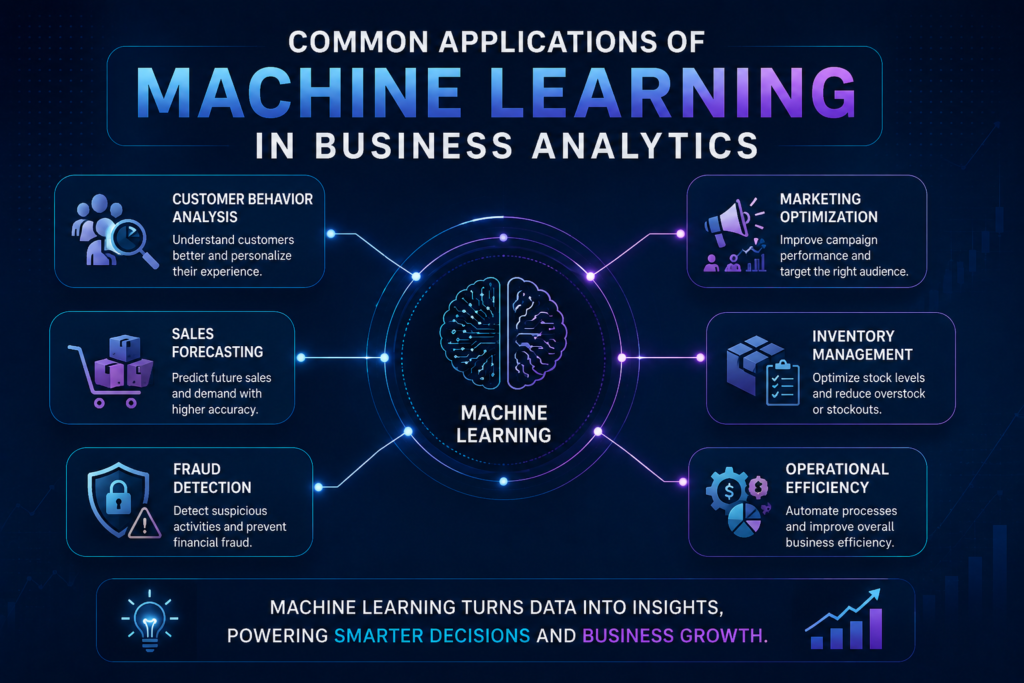
Machine learning is used across many business functions.
Customer Behavior Analysis
Businesses use machine learning to understand customer preferences, buying patterns, and engagement trends.
For a real-world example, read AI in Customer Behavior Analysis
Sales Forecasting
Machine learning helps estimate future sales based on seasonality, customer demand, and historical purchasing behavior.
Fraud Detection
Financial institutions use machine learning to detect suspicious transactions and unusual behavior in real time.
Marketing Optimization
Companies use predictive models to identify target audiences and improve campaign performance.
Inventory Management
Retail businesses use machine learning to forecast demand and reduce overstocking or shortages.
Machine Learning vs Traditional Business Analytics
Traditional business analytics mainly focuses on historical reporting and manual interpretation.
Machine learning adds a predictive and adaptive layer.
Traditional Business Analytics
- historical reports
- manual analysis
- slower decision cycles
- limited scalability
Machine Learning Analytics
- predictive modeling
- automated insights
- real-time pattern recognition
- continuous improvement
To understand this comparison in more detail, read AI vs Traditional Business Analysis 2026
Benefits of Machine Learning in Business Analytics
Faster Decision-Making
Machine learning processes data much faster than manual methods.
Better Accuracy
Models improve over time and reduce human error.
Predictive Insights
Businesses can anticipate future trends rather than only reviewing past performance.
Cost Efficiency
Automation reduces manual workload and operational inefficiencies.
Scalability
Machine learning can analyze massive datasets across departments and markets.
These advantages make machine learning an essential part of modern business strategy.
Challenges of Using Machine Learning
Although machine learning offers major benefits, businesses must address some practical challenges.
Data Quality
Poor-quality data can lead to weak or inaccurate predictions.
Implementation Cost
Building infrastructure and acquiring tools can require investment.
Skill Gaps
Organizations may need analysts who understand both business goals and machine learning concepts.
Ethical and Privacy Concerns
Businesses must use customer data responsibly and transparently.
With proper planning, these challenges can be managed successfully.
The Role of AI Business Analysts
Machine learning does not replace human decision-makers. Instead, it supports analysts by providing faster and deeper insights.
AI business analysts help translate machine learning outputs into business recommendations.
If you want to explore this career path, read How to Become an AI Business Analyst in 2026
Analysts remain important because business context, strategy, and human judgment still matter.
For a strong foundation in machine learning concepts, see IBM’s Machine Learning Guide
Future of Machine Learning in Business Analytics
The role of machine learning in business analytics will continue to grow.
In the coming years, businesses will increasingly use machine learning for:
- real-time decision support
- intelligent automation
- advanced forecasting
- customer personalization
- strategic business planning
Organizations that adopt machine learning early will gain stronger competitive advantages.
Rather than replacing human expertise, machine learning will enhance decision-making and improve business agility.
FAQ
What is machine learning in business analytics?
Machine learning in business analytics uses algorithms that learn from data to generate insights, detect patterns, and predict future outcomes.
How does machine learning help businesses?
It helps businesses improve forecasting, automate analysis, reduce costs, and make faster decisions.
Is machine learning replacing business analysts?
No. Machine learning supports analysts by providing deeper insights, while human expertise remains essential.
What industries use machine learning in business analytics?
Retail, finance, healthcare, marketing, logistics, and technology companies all use machine learning.
Why is machine learning important in 2026?
Because businesses need faster, smarter, and more scalable ways to analyze growing amounts of data.
Conclusion
Machine learning in business analytics is becoming a major driver of modern business growth.
It allows organizations to analyze large datasets, identify patterns, predict future outcomes, and make more informed decisions.
As businesses continue to evolve in 2026, machine learning will play an increasingly important role in building smarter, faster, and more competitive organizations.