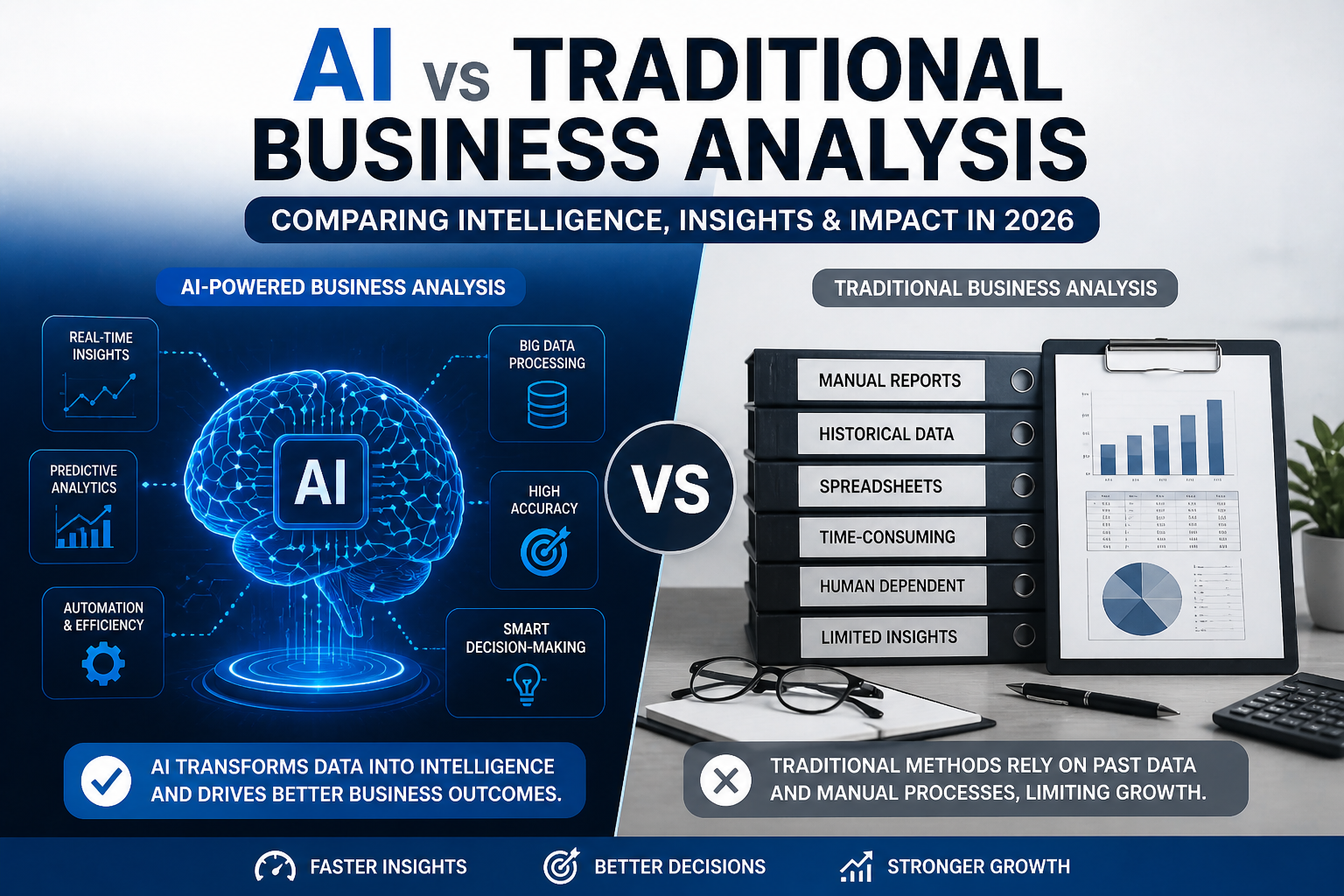
Explore AI vs traditional business analysis 2026, including key differences, benefits, and how artificial intelligence is transforming modern business decision-making.
AI vs Traditional Business Analysis 2026
Introduction
Business analysis has always been an important part of decision-making in organizations. Traditionally, businesses relied on manual data analysis, human judgment, and historical data to make decisions. However, with the rise of artificial intelligence, the way businesses analyze data has changed significantly.
In 2026, the comparison between AI and traditional business analysis is more relevant than ever. Companies are shifting towards AI-powered systems to improve accuracy, speed, and efficiency. Understanding the difference between these two approaches helps businesses choose the right strategy for growth.
What is Traditional Business Analysis?
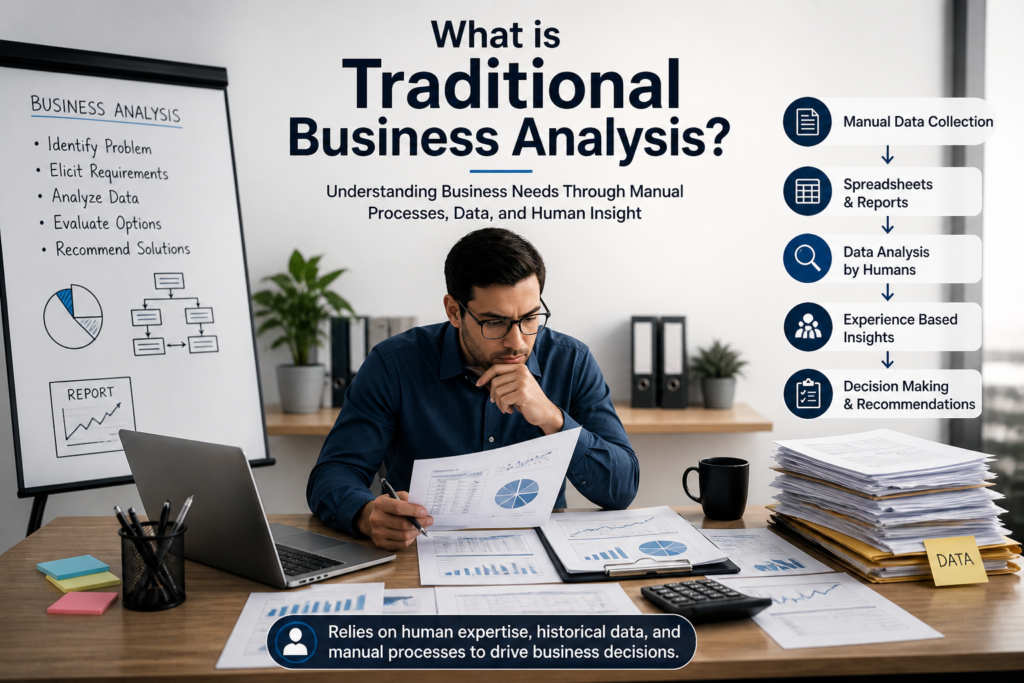
Traditional business analysis involves analyzing business data manually using spreadsheets, reports, and human interpretation.
It focuses on:
- Historical data
- Manual reporting
- Human decision-making
- Limited data processing
While traditional methods are still useful, they can be time-consuming and less accurate when dealing with large datasets.
What is AI in Business Analysis?
AI in business analysis uses artificial intelligence technologies such as machine learning and predictive analytics to analyze data automatically.
It helps businesses:
- Process large volumes of data
- Predict future trends
- Automate decision-making
- Generate real-time insights
To understand this concept in detail, read:
Artificial Intelligence Business Analysis 2026
Key Differences Between AI and Traditional Business Analysis
Speed and Efficiency
Traditional analysis is slow and manual, while AI processes data instantly.
Accuracy
AI reduces human error and provides more accurate insights.
Data Handling
AI can handle large and complex datasets, unlike traditional methods.
Decision-Making
Traditional methods rely on past data, while AI predicts future outcomes.
Automation
AI automates repetitive tasks, saving time and effort.
Benefits of AI Over Traditional Business Analysis
AI offers several advantages compared to traditional methods:
- Faster data processing
- Better prediction accuracy
- Real-time insights
- Improved decision-making
- Reduced operational costs
These benefits make AI a preferred choice for modern businesses.
When Traditional Business Analysis is Still Useful
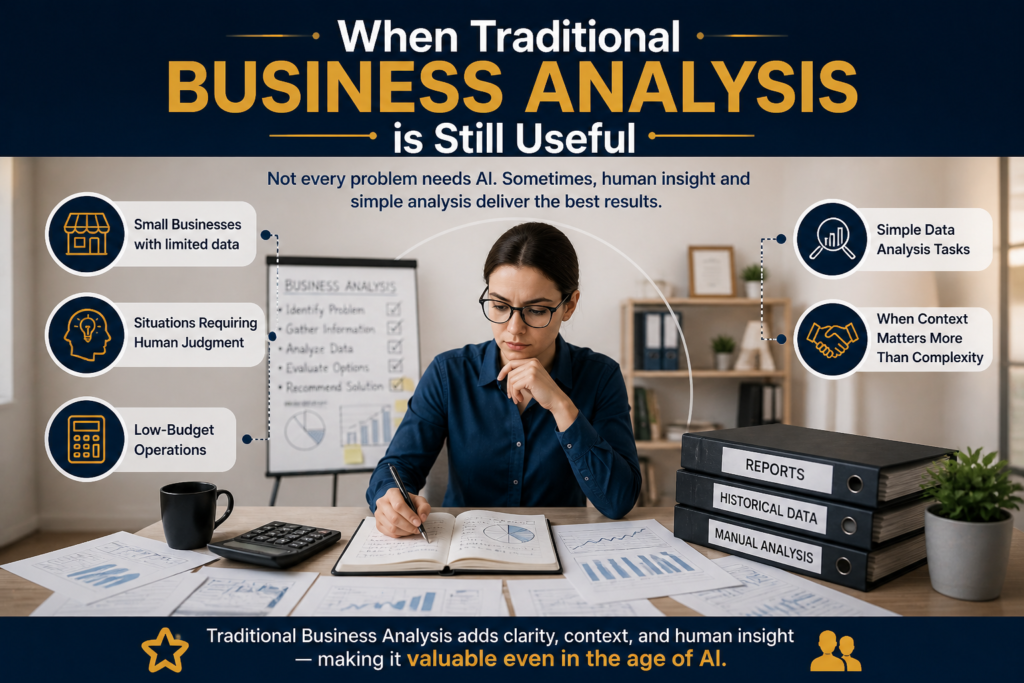
Despite the rise of AI, traditional business analysis still has its importance:
- Small businesses with limited data
- Situations requiring human judgment
- Low-budget operations
- Simple data analysis tasks
In many cases, businesses use a combination of both methods.
Real-World Use Case
Modern companies use AI to analyze customer behavior, predict sales trends, and improve marketing strategies.
To see how AI is used in real scenarios, explore: AI in Customer Behavior Analysis
Role of AI Business Analysts
AI business analysts play a key role in modern organizations. They use AI tools to analyze data and help businesses make strategic decisions.
If you want to build a career in this field, read:
How to Become an AI Business Analyst in 2026
Future of AI vs Traditional Business Analysis
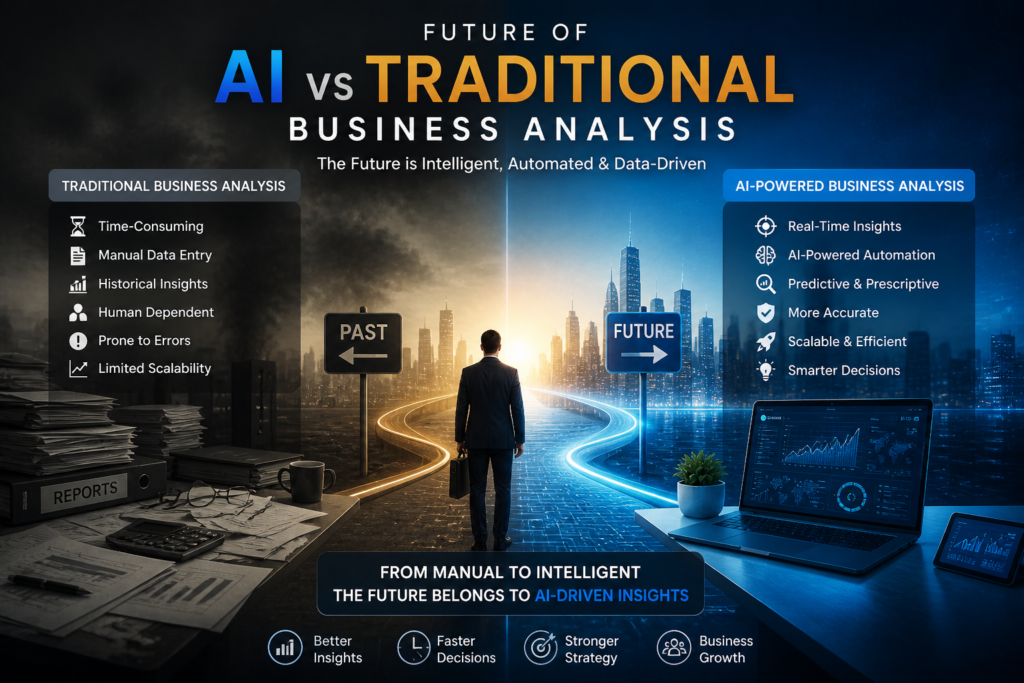
The future clearly favors AI-driven business analysis. As technology continues to evolve, businesses will rely more on AI for decision-making.
However, traditional business analysis will not disappear completely. Instead, it will work alongside AI to provide a balanced approach.
Businesses that combine both methods effectively will achieve the best results.
For a deeper understanding of business analysis concepts:
FAQ
What is the main difference between AI and traditional business analysis?
AI uses automation and predictive analytics, while traditional analysis relies on manual processes and historical data.
Is AI better than traditional business analysis?
AI is more efficient and accurate, but traditional methods are still useful in certain situations.
Can AI replace business analysts?
No, AI supports analysts but does not replace them completely.
Why are businesses shifting to AI?
Because AI provides faster insights, better accuracy, and improved decision-making.
What is the future of business analysis?
The future involves a combination of AI and human expertise.
Conclusion
AI vs traditional business analysis is a key topic in 2026. While traditional methods laid the foundation, AI is transforming how businesses analyze data and make decisions.
Organizations that adopt AI while maintaining human expertise will stay ahead in the competitive market.