AI Visibility vs SEO – What’s the Difference? Complete 2026 Guide
Learn the complete difference between AI Visibility vs SEO, how AI search engines rank content, and why businesses need both strategies to increase online visibility in 2026.
AI Visibility vs SEO: What’s the Difference and Why Does It Matter?
Search is changing faster than ever. A few years ago, businesses mainly focused on ranking higher in Google using traditional SEO. Today, people also search using AI-powered platforms like ChatGPT, Google AI Overviews, Gemini, Perplexity AI, and Microsoft Copilot. Instead of showing a list of websites, these tools often generate direct answers using information collected from trusted online sources.
This shift has introduced a new concept called AI Visibility. While SEO helps your pages rank in search engine results, AI Visibility focuses on making your content easy for AI systems to discover, understand, trust, and reference when generating answers.
Many website owners believe AI Visibility will replace SEO, while others think SEO alone is enough. The truth is that both strategies work together. Traditional SEO remains essential for organic rankings, but AI Visibility prepares your content for the future of search where AI assistants play a much larger role.
In this guide, you’ll learn the real difference between AI Visibility vs SEO, how each strategy works, where they overlap, and how combining them can improve your website’s long-term performance.
If you’re just beginning your AI search journey, start by reading AI Visibility Products to understand the tools and technologies shaping AI-powered search.
What Is AI Visibility?
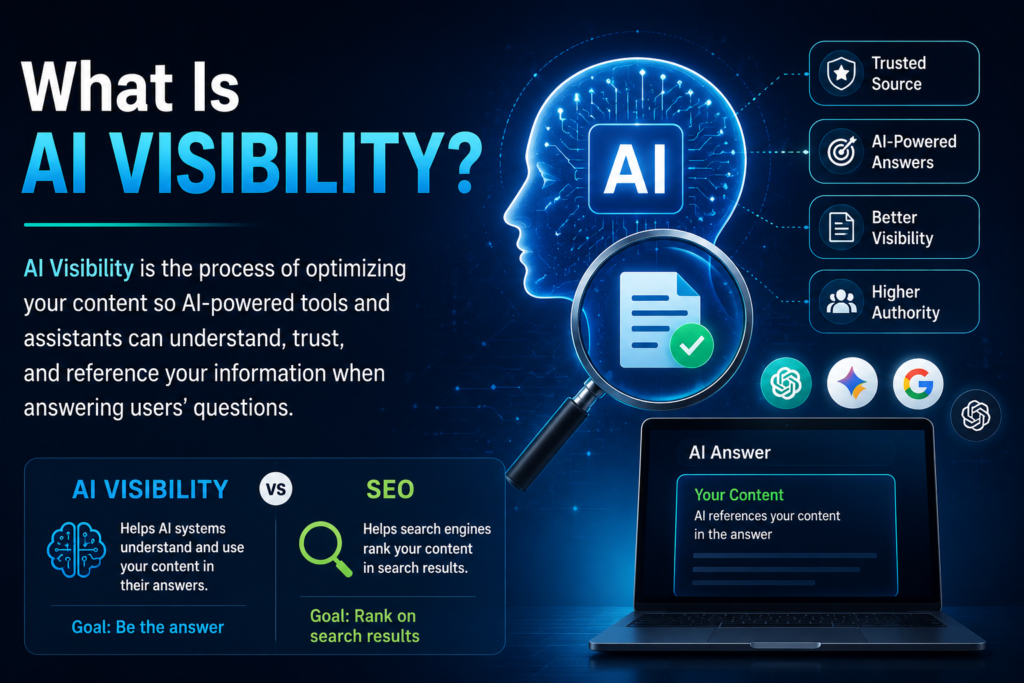
AI Visibility is the process of making your content understandable, trustworthy, and easy for artificial intelligence systems to reference when answering user questions.
Unlike traditional search engines that rank web pages, AI assistants analyze information from multiple trusted sources before generating a response. Your goal is not only to appear in search results but also to become one of the sources AI models rely on when creating answers.
For example, if someone asks:
“What is the difference between AI Visibility and SEO?”
An AI assistant may summarize information from several authoritative websites instead of simply displaying ten blue links. If your content is well-structured, factually accurate, and demonstrates expertise, it has a better chance of being included in that generated answer.
AI Visibility depends on several important factors:
- Clear and logical content structure
- Accurate, helpful information
- Strong topical authority
- Consistent publishing
- Entity optimization
- Natural language writing
- High trust signals
- EEAT principles
- Proper schema markup
- Relevant citations and references
Instead of optimizing only for keywords, AI Visibility focuses on helping machines understand the meaning and context of your content.
To learn more about how AI-powered optimization works, explore AI SEO Tools Visibility Optimization and related resources available on Power AI Engine.
What Is Traditional SEO?
Search Engine Optimization (SEO) is the practice of improving your website so it ranks higher in search engine results pages (SERPs). The main objective is to increase organic traffic by helping search engines understand the relevance and quality of your content.
SEO has evolved significantly over the years. Modern SEO is no longer just about keywords and backlinks. It now emphasizes user experience, content quality, website performance, technical optimization, and credibility.
A successful SEO strategy usually includes:
- Keyword research
- High-quality content creation
- Technical SEO improvements
- Internal linking
- Mobile optimization
- Fast page speed
- Quality backlinks
- Image optimization
- Structured data
- User experience enhancements
Google’s algorithms continue to reward websites that publish original, useful, and reliable information rather than content created only to manipulate rankings.
If you’re new to this topic, our guide on Role of AI in SEO Visibility for Small Websites explains how traditional SEO and AI-driven optimization can work together.
AI Visibility vs SEO: Quick Comparison
| Feature | AI Visibility | Traditional SEO |
|---|---|---|
| Primary Goal | Become a trusted AI reference | Rank higher in search results |
| Focus | AI-generated answers | Search engine rankings |
| Audience | AI assistants and users | Search engines and users |
| Optimization | Context, entities, EEAT, structured knowledge | Keywords, backlinks, technical SEO |
| Content Style | Conversational and comprehensive | Search intent focused |
| Success Metric | AI mentions, citations, answer inclusion | Rankings, impressions, clicks |
| Platforms | ChatGPT, Gemini, Perplexity, AI Overviews | Google, Bing, Yahoo |
| Importance | Growing rapidly | Still essential |
The biggest difference is simple:
SEO helps users find your website. AI Visibility helps AI systems confidently use your content when answering questions.
The strongest digital marketing strategy combines both approaches rather than choosing one over the other.
How AI Visibility and SEO Differ in Practice
Although AI Visibility and traditional SEO share the same ultimate goal—helping people discover valuable information—they achieve it in different ways.
Traditional SEO focuses on improving your website so search engines rank it higher in search results. AI Visibility goes one step further by making your content easy for AI systems to understand, trust, and reference when generating answers.
Think of it this way:
- SEO helps your website appear before a user clicks.
- AI Visibility helps your content appear inside the AI-generated answer.
As AI-powered search becomes more common, businesses that invest in both strategies are more likely to maintain long-term visibility across multiple search experiences.
AI Visibility vs SEO: The Major Differences
1. Different Goals
The primary goal of SEO is to improve rankings in search engine results pages (SERPs). When users search on Google or Bing, optimized pages have a better chance of appearing near the top.
AI Visibility has a different objective. Instead of ranking a page, it focuses on helping AI systems recognize your content as a reliable source when answering questions.
For example:
- SEO aims to rank for “AI Visibility vs SEO.”
- AI Visibility aims to have your explanation included in an AI-generated response about that topic.
This difference is why businesses should no longer rely on rankings alone as their only measure of success.
If you’re building a future-ready content strategy, our guide on AI Visibility Products explains how AI search technologies are evolving and what they mean for website owners.
If you’re creating articles with AI assistance, read Best AI for Blog Writing in 2025 to discover the top AI writing tools for creating high-quality, SEO-friendly content.
2. Ranking Factors Are Different
Google uses hundreds of ranking signals to determine where pages appear in search results. While many of these signals still matter for AI Visibility, AI systems evaluate information differently.
Traditional SEO Ranking Signals
- Relevant keywords
- Quality backlinks
- Internal linking
- Mobile-friendly design
- Fast loading speed
- Core Web Vitals
- Search intent satisfaction
- Fresh content
- Technical SEO
AI Visibility Signals
- Clear explanations
- Topical authority
- Entity relationships
- EEAT signals
- Accurate facts
- Logical content hierarchy
- Structured data
- Consistent publishing
- Reliable citations
- Natural language
AI assistants are designed to understand concepts rather than simply matching keywords.
For example, if someone asks:
“Should small businesses focus on AI Visibility or SEO?”
An AI assistant looks for the most complete, trustworthy, and well-organized explanation instead of just counting keyword usage.
AI Search vs Traditional Search Engines
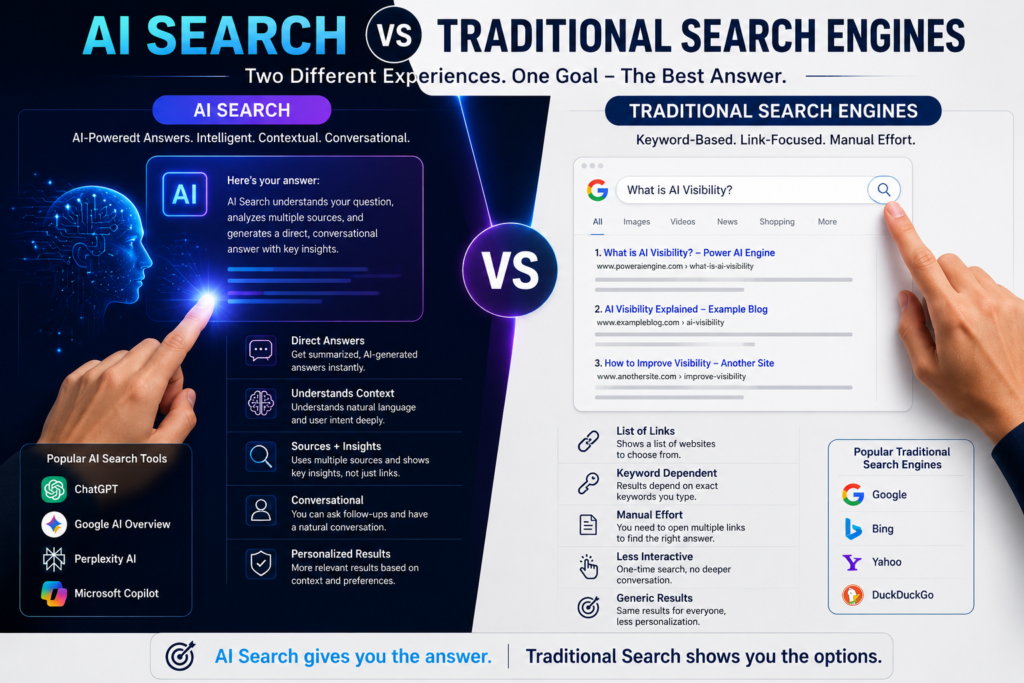
One of the biggest differences is how results are delivered.
Traditional Search
Users receive a list of web pages.
They compare titles, read snippets, and choose which result to visit.
Success depends heavily on:
- Click-through rate
- Rankings
- Rich snippets
- Meta titles
- Meta descriptions
AI Search
AI-powered search delivers a direct answer.
Instead of requiring users to visit multiple websites, AI combines information from trusted sources into one conversational response.
This creates a new challenge for publishers.
Your content must not only rank—it must also be trustworthy enough for AI systems to reference.
That’s why detailed pillar content often performs better than thin articles.
To understand this trend in more detail, read What Are AI Visibility Products in SEO for Beginners, where we explain how AI-powered discovery differs from traditional indexing.
How Content Optimization Has Changed
A few years ago, many websites could rank simply by targeting one keyword and building backlinks.
That approach is no longer enough.
Today’s successful content usually includes:
- Complete topic coverage
- Helpful examples
- Simple explanations
- Expert insights
- Updated information
- Natural language
- Question-based headings
- Strong internal linking
- Clear formatting
This benefits both Google and AI systems.
Instead of asking,
“Did this page use the keyword enough?”
AI asks,
“Does this page completely answer the user’s question?”
That mindset should shape every article you publish.
Why EEAT Matters More Than Ever
Google introduced EEAT to encourage high-quality, trustworthy content.
EEAT stands for:
- Experience
- Expertise
- Authoritativeness
- Trustworthiness
These principles have become equally valuable for AI Visibility because AI assistants aim to provide reliable answers.
Strong EEAT signals include:
- Publishing original research
- Updating articles regularly
- Citing trustworthy sources
- Using accurate statistics
- Demonstrating real expertise
- Maintaining consistent topical coverage
For websites in competitive industries like AI and SEO, EEAT is no longer optional—it is a core ranking and visibility factor.
Google also recommends creating helpful, reliable, people-first content that demonstrates expertise and satisfies user intent rather than writing content only to rank in search results. You can learn more from Google’s Helpful Content guidelines.
Why Businesses Need Both AI Visibility and SEO
Some marketers ask:
“Should I stop doing SEO and only focus on AI Visibility?”
The answer is no.
SEO continues to drive valuable organic traffic, while AI Visibility helps your content remain discoverable as search behavior evolves.
Together, they create a stronger digital strategy.
Benefits of Combining Both
- More organic traffic
- Better visibility in AI-generated answers
- Increased brand authority
- Higher trust among users
- Improved topical relevance
- Stronger long-term rankings
- Better user experience
- Greater resilience to future algorithm changes
Businesses that combine these approaches are better positioned for both today’s search engines and tomorrow’s AI-powered search experiences.
Benefits and Limitations of AI Visibility and SEO
Understanding the strengths and weaknesses of both AI Visibility and traditional SEO helps you build a smarter digital marketing strategy. Neither approach is perfect on its own. When combined, however, they create a powerful foundation for long-term online growth.
Instead of choosing one over the other, businesses should understand where each strategy performs best and how they complement one another.
Benefits of AI Visibility
AI Visibility is becoming increasingly important because millions of users now ask questions directly to AI assistants instead of relying only on traditional search engines.
When your content is optimized for AI search, it has a better chance of being referenced in AI-generated responses Artificial General Intelligence (AGI)
1. Greater Brand Recognition
Even if users don’t immediately visit your website, seeing your brand referenced in AI-generated answers builds familiarity and trust.
Over time, repeated exposure can increase branded searches, direct traffic, and customer confidence.
2. Improved Topical Authority
AI systems prefer websites that consistently publish high-quality content around a specific subject.
For example, if Power AI Engine publishes comprehensive articles on:
- AI Visibility Products
- Role of AI in SEO Visibility
- Top AI Tools for SEO
- SEO Automation Services
- AI Marketing
- Artificial General Intelligence (AGI)
AI models are more likely to recognize the website as an authority in AI and SEO.
This is why publishing connected pillar pages and supporting cluster articles is more effective than creating unrelated content.
3. Better User Experience
AI Visibility encourages content creators to answer questions clearly instead of writing only for search engines.
Helpful content usually includes:
- Simple language
- Logical headings
- Real examples
- Actionable advice
- Complete explanations
This improves readability for both users and AI systems.
4. Future-Proof Content Strategy
Search behavior continues to evolve.
Users increasingly rely on conversational search experiences rather than typing short keyword phrases.
Optimizing for AI Visibility prepares your content for future search technologies while continuing to support traditional SEO efforts.
Benefits of Traditional SEO
Although AI search is growing quickly, traditional search engines still generate billions of searches every day.
SEO remains one of the most effective long-term digital marketing strategies.
Higher Organic Traffic
Well-optimized pages can consistently attract visitors without paying for advertising.
Unlike paid campaigns, organic rankings can continue generating traffic for months or even years with regular updates.
Better Click-Through Rates
Strong SEO improves:
- Page titles
- Meta descriptions
- Rich snippets
- Featured snippets
These elements encourage more users to click your website from search results.
Long-Term Growth
SEO builds a valuable digital asset.
As your website gains authority, new content often ranks faster because search engines already trust your domain.
This makes SEO an excellent long-term investment.
Limitations of AI Visibility
Despite its growing importance, AI Visibility has some challenges.
AI Mentions Are Less Predictable
Unlike traditional rankings, AI-generated responses change frequently.
An AI assistant may reference your website today but choose another trusted source tomorrow based on updated information or a different query.
This makes AI Visibility harder to measure than traditional SEO.
Limited Analytics
Google Search Console shows impressions, clicks, and rankings for search results.
AI platforms currently provide much less data about:
- Citation frequency
- Answer inclusion
- User interactions
- Referral behavior
As AI search evolves, better reporting tools are expected, but analytics are still developing.
Constant AI Evolution
AI models are improving rapidly.
Content strategies that work today may require adjustments as AI systems become better at evaluating quality, context, and trustworthiness.
Regular content updates are essential.
Limitations of Traditional SEO
SEO also has its own challenges.
High Competition
Many industries have thousands of websites competing for the same keywords.
Ranking on the first page often requires:
- Excellent content
- Strong backlinks
- Technical optimization
- Consistent updates
This can take months to achieve.
Frequent Algorithm Updates
Search engines regularly update their ranking systems.
An article that performs well today may lose visibility if it is not maintained.
Updating pillar content regularly helps protect rankings.
Keyword-Focused Strategies Alone No Longer Work
Older SEO methods often emphasized keyword density.
Modern search engines reward:
- Helpful information
- User satisfaction
- Topical authority
- Experience
- Trustworthiness
Publishing content only to target keywords is unlikely to deliver sustainable results.
Real-World Example: AI Visibility vs SEO
Imagine two websites publish an article about AI Visibility vs SEO. AI in Customer Behavior Analysis
Website A
- Uses the keyword repeatedly.
- Contains 800 words.
- Few headings.
- No internal links.
- Outdated information.
- No examples.
Website B
- Covers the topic in depth.
- Answers common user questions.
- Uses clear headings.
- Includes diagrams or comparison tables.
- Links to related articles.
- Demonstrates expertise.
- Updates content regularly.
Which website is more likely to succeed?
Website B has a stronger chance of:
- Ranking in Google.
- Appearing in AI-generated answers.
- Earning backlinks.
- Building reader trust.
- Becoming a topical authority.
This example highlights why comprehensive, user-focused content consistently outperforms thin articles.
The Future of AI Visibility and SEO
The future of search is not about replacing SEO with AI Visibility—it is about integrating both into a unified content strategy.
Several trends are already shaping this future:
- AI-generated search experiences will continue to grow.
- Search engines will place even greater emphasis on content quality and trust.
- Topical authority will become more important than isolated keyword optimization.
- Structured data and semantic relationships will play a larger role in helping AI understand content.
- Brands that publish accurate, comprehensive, and regularly updated information will have a competitive advantage.
Businesses that begin optimizing for AI Visibility today will be better prepared as AI-powered search becomes a standard part of how people find information online Synthetic Intelligence vs Artificial Intelligence
How to Optimize for Both AI Visibility and SEO
If you want your content to rank well in Google and become a trusted source for AI-powered search, you need a strategy that combines traditional SEO with AI Visibility best practices.
The good news is that many optimization techniques support both goals. The difference is that AI Visibility places greater emphasis on context, topical authority, and trust, while SEO continues to value technical performance, search intent, and user experience.
The following framework can help you build content that performs well across both traditional and AI-driven search experiences.
Step 1: Build Comprehensive Pillar Content
One of the most effective ways to improve AI Visibility and SEO is to create detailed pillar pages that cover a topic from every important angle.
Instead of publishing several short articles on the same subject, develop one comprehensive guide and support it with related cluster content.
For example, this article on AI Visibility vs SEO should connect naturally to other resources on your website, including:
- AI Visibility Products
- Role of AI in SEO Visibility for Small Websites
- Top AI Tools for SEO
- SEO Automation Services
- Best AI for Blog Writing in 2026
- What Is an AI Agent?
- AI Marketing
- Artificial General Intelligence (AGI)
- Synthetic Intelligence vs Artificial Intelligence
- Google Algorithm Updates 2026
This content hub signals to both search engines and AI systems that your website has deep expertise in AI and SEO.
Step 2: Write for People First
The most successful content is written for real users—not algorithms.
Instead of asking, “How many times should I use my keyword?” ask, “What questions does my audience need answered?”
Use:
- Clear introductions
- Short paragraphs
- Descriptive headings
- Practical examples
- Simple English
- Helpful comparisons
- Actionable advice
When users easily understand your content, AI systems can usually understand it better as well.
Step 3: Strengthen Your EEAT Signals
Experience, Expertise, Authoritativeness, and Trustworthiness (EEAT) have become essential for modern SEO and AI Visibility.
You can strengthen these signals by:
- Publishing original, experience-based content.
- Updating articles regularly with current information.
- Explaining concepts accurately and clearly.
- Citing reputable sources when appropriate.
- Maintaining a consistent publishing schedule.
- Building topical authority through interconnected articles.
For a website like Power AI Engine, consistently covering AI, SEO, automation, and search technology helps establish long-term credibility.
Step 4: Create a Strong Internal Linking Structure
Internal links help users discover related content while also helping search engines and AI systems understand your website’s structure.
For this pillar page, include contextual links to relevant articles using descriptive anchor text rather than generic phrases like “click here.”
Here are recommended internal links (use bold anchors in your article):
- AI Visibility Products
- Role of AI in SEO Visibility for Small Websites
- Top AI Tools for SEO
- Best AI for Blog Writing in 2026
- SEO Automation Services
- What Is an AI Agent?
- AI Marketing
- Artificial General Intelligence (AGI)
- Synthetic Intelligence vs Artificial Intelligence
- Google Algorithm Updates 2026
- AI in Customer Behavior Analysis
- How Businesses Improve Strategy Using AI Insights
These links create a logical topic cluster that strengthens your website’s overall authority.
Step 5: Use Structured Content
AI systems process well-organized information more effectively than large blocks of text.
Structure your content with:
- A clear H1 title.
- Logical H2 and H3 headings.
- Comparison tables.
- Bullet points where appropriate.
- FAQ sections.
- Definitions near the beginning.
- Step-by-step guidance.
- Short summaries after major sections.
This structure improves readability and increases the likelihood of appearing in featured snippets and AI-generated answers.
o help search engines and AI systems understand your content more effectively, implement structured data based on Schema.org standards. Proper schema markup can improve your chances of appearing in rich results and AI-powered search experiences.
Common Mistakes to Avoid
Many websites struggle because they focus on outdated SEO tactics or overlook the needs of AI-powered search.
Avoid these common mistakes:
Keyword Stuffing
Repeating the same keyword unnaturally reduces readability and can weaken your content.
Instead, use natural language and related terms.
Publishing Thin Content
Short articles that only scratch the surface rarely perform well.
Create comprehensive content that fully answers user questions.
Ignoring Search Intent
Every article should satisfy the reason behind the search.
Someone searching for “AI Visibility vs SEO” expects a detailed comparison, practical guidance, and real-world examples—not a brief definition.
Poor Internal Linking
Articles that stand alone miss opportunities to build topical authority.
Every important page should connect naturally to related resources.
Failing to Update Content
AI and SEO evolve quickly.
Review your pillar pages every few months to:
- Refresh statistics.
- Add new examples.
- Improve explanations.
- Expand sections where needed.
- Update internal links.
Regular updates help maintain rankings and keep your content relevant.
Best Practices for Long-Term Success
To maximize both AI Visibility and SEO, follow these proven practices:
- Publish original, experience-driven content.
- Cover topics comprehensively.
- Use clear and conversational language.
- Build topic clusters around your core subjects.
- Add relevant internal links throughout your articles.
- Optimize page speed and mobile usability.
- Use schema markup to help search engines understand your content.
- Earn backlinks from reputable websites.
- Monitor performance and update content regularly.
These habits create a strong foundation for sustainable organic growth.
Frequently Asked Questions (FAQs)
What is the main difference between AI Visibility and SEO?
The biggest difference is their purpose. SEO focuses on improving your website’s rankings in search engine results, while AI Visibility focuses on making your content understandable and trustworthy enough to be referenced by AI-powered search tools like ChatGPT, Google AI Overviews, Gemini, and Perplexity. Businesses that combine both strategies are better positioned for the future of online search.
Is AI Visibility replacing SEO?
No. AI Visibility is not replacing SEO—it is expanding it.
Traditional SEO remains essential for attracting organic traffic from search engines. AI Visibility complements SEO by helping your content appear in AI-generated answers. Together, they create a stronger and more future-ready digital marketing strategy.
How can I improve my AI Visibility?
You can improve AI Visibility by:
- Publishing comprehensive, people-first content.
- Building topical authority with related articles.
- Following EEAT principles.
- Using clear headings and logical content structure.
- Adding schema markup.
- Maintaining strong internal linking.
- Updating content regularly.
- Referencing credible sources where appropriate.
These practices also strengthen your overall SEO performance.
Does AI Visibility help Google rankings?
While AI Visibility is not a direct Google ranking factor, many of its best practices overlap with modern SEO.
Helpful, well-structured, trustworthy content tends to perform better in search results and is also more likely to be referenced by AI systems. Optimizing for both creates a stronger foundation for long-term visibility.
Should small businesses focus on AI Visibility?
Yes. Small businesses can benefit significantly from AI Visibility because it rewards expertise, content quality, and topical authority—not just brand size.
By publishing detailed, accurate content in a specific niche, smaller websites can compete with larger competitors in both traditional and AI-powered search.
What is the future of AI Visibility and SEO?
The future of search will combine traditional rankings with AI-generated experiences.
Businesses that consistently publish trustworthy, comprehensive, and user-focused content will be better prepared as AI becomes a larger part of how people discover information online.
Conclusion
The debate around AI Visibility vs SEO is not about choosing one strategy over the other. Instead, it is about understanding how both approaches work together to improve online visibility.
SEO continues to play a vital role in helping websites rank in search engines and attract organic traffic. At the same time, AI Visibility ensures that your content is structured, trustworthy, and comprehensive enough to be understood and referenced by AI-powered search experiences Artificial Intelligence Business Analysis 2026
As more users rely on conversational search tools, businesses must adapt their content strategies. Publishing high-quality pillar pages, building topical authority, strengthening EEAT, and maintaining a well-organized internal linking structure are no longer optional—they are essential for long-term success.
Whether you are a blogger, marketer, business owner, or SEO professional, investing in both AI Visibility and SEO will help you build a stronger digital presence and stay competitive as search continues to evolve AI vs Traditional Business Analysis 2026