
Learn what is AGI in AI means, how Artificial General Intelligence works, its benefits, challenges, future impact, and the difference between AI and AGI in simple words.
What Is AGI in AI? The Future of Artificial General Intelligence
Artificial Intelligence is rapidly changing the digital world. From AI chatbots and virtual assistants to automation tools and smart recommendation systems, AI technology is now part of everyday life. However, most AI systems today are designed for specific tasks only. This is where the concept of AGI in AI becomes important.
AGI stands for Artificial General Intelligence. It refers to a future type of AI that can think, learn, understand, and solve problems like a human being. Unlike traditional AI systems that focus on one task, AGI would be capable of performing multiple intellectual activities without requiring separate programming for each one.
As AI technology continues advancing, researchers and tech companies are investing heavily in AGI development. Many experts believe AGI could become one of the most transformative technologies in human history because of its potential to revolutionize industries, businesses, education, healthcare, and scientific research.
In this article, you will learn what AGI in AI means, how it works, its benefits, challenges, future possibilities, and the key differences between AI and AGI.
What Is AGI in AI?
Artificial General Intelligence (AGI) is an advanced form of artificial intelligence capable of performing human-like thinking and reasoning across different tasks. AGI systems are designed to learn from experiences, adapt to new situations, and solve unfamiliar problems without needing specialized programming.
Current AI technologies are examples of Narrow AI. These systems work efficiently within specific tasks such as:
- Writing content
- Generating images
- Voice recognition
- Language translation
- Data analysis
- Recommendation systems
Although these AI tools are powerful, they cannot think independently beyond their training data. AGI aims to overcome these limitations by creating systems with generalized intelligence similar to humans.
An AGI-powered system could potentially:
- Understand emotions and context
- Learn new skills automatically
- Solve complex real-world problems
- Make independent decisions
- Adapt to changing environments
- Perform multiple tasks without retraining
This is what makes AGI different from modern AI systems.
Difference Between AI and AGI
Many people often confuse AI with AGI, but both technologies are very different.
Traditional AI systems focus on performing limited tasks based on specific training data. For example, a chatbot can answer questions, but it cannot independently learn a completely new skill outside its programming.
AGI, on the other hand, would work similarly to human intelligence. It could analyze situations, learn continuously, and apply knowledge across different areas without needing separate training for every task.
AI vs AGI Comparison
| Feature | Narrow AI | AGI |
|---|---|---|
| Intelligence Type | Task-specific | Human-like |
| Learning Ability | Limited | Continuous |
| Adaptability | Low | High |
| Problem Solving | Pre-trained tasks | New situations |
| Human Reasoning | Minimal | Advanced |
Today’s AI systems are highly efficient, but AGI remains a future goal that researchers are still working toward.
For a better understanding of how AI is transforming industries, you can also read our guide on AI in Higher Education:
AI in higher Education
How Does AGI Work?
AGI is expected to combine multiple advanced technologies together to simulate human intelligence. Researchers believe AGI systems may rely on several core technologies, including machine learning, neural networks, natural language processing, and cognitive computing.
Machine Learning
Machine learning allows AI systems to learn from data and improve performance over time without manual programming.
Neural Networks
Neural networks are inspired by the human brain and help AI recognize patterns, process information, and make predictions.
Natural Language Processing (NLP)
NLP enables AI systems to understand and communicate using human language naturally.
Reinforcement Learning
Reinforcement learning helps AI improve by interacting with environments and learning from rewards or mistakes.
Cognitive Computing
Cognitive computing focuses on reasoning, decision-making, and problem-solving abilities similar to human thinking.
By combining these technologies, AGI could eventually develop the ability to think, reason, and adapt independently.
Benefits of AGI in AI
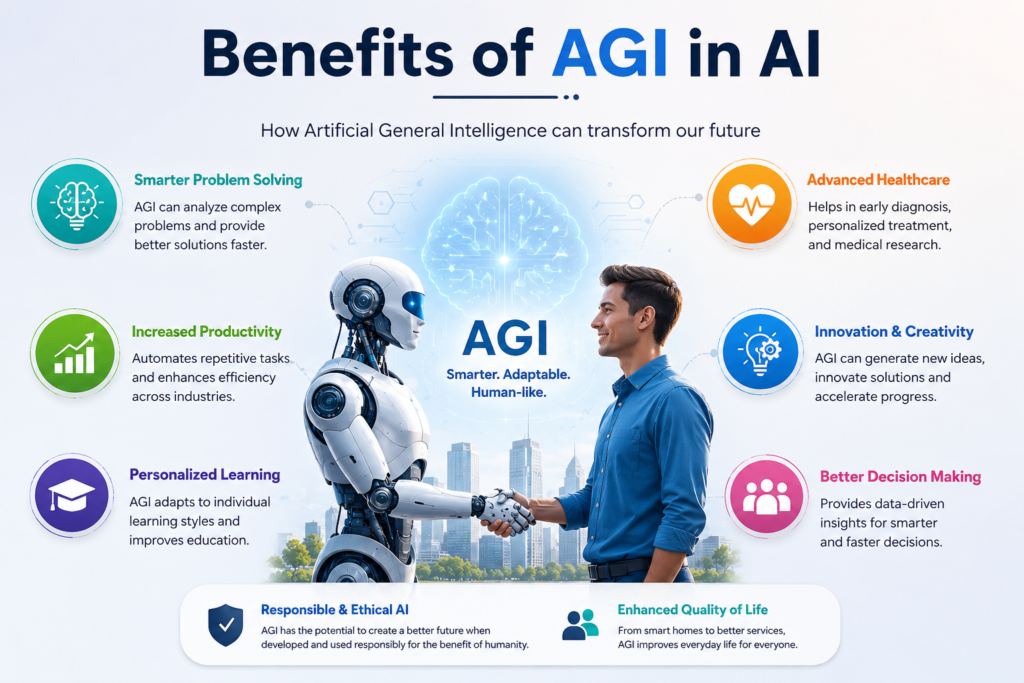
AGI has the potential to transform almost every industry. Because it could think and learn like humans, AGI may solve highly complex problems faster and more efficiently than current technologies.
Improved Healthcare
AGI could help doctors diagnose diseases earlier, analyze medical reports quickly, and create personalized treatment plans for patients.
Smarter Education
Educational systems powered by AGI may provide customized learning experiences based on each student’s needs and learning style.
Better Business Automation
Businesses could use AGI for intelligent automation, customer service, market analysis, and strategic decision-making.
Scientific Discoveries
Researchers believe AGI could accelerate discoveries in medicine, climate science, engineering, and space exploration.
Advanced Problem Solving
AGI systems may help solve global challenges by analyzing massive amounts of data and identifying innovative solutions.
If you are interested in AI-driven business careers, you can also explore:
How to become an ai business analyst
Real-World Technologies Moving Toward AGI
Although true AGI does not exist yet, several modern technologies are considered early steps toward general intelligence.
AI Chatbots
Advanced AI chatbots can answer questions, summarize information, and generate human-like conversations.
Autonomous Vehicles
Self-driving cars use AI systems to analyze road conditions and make real-time driving decisions.
AI Research Assistants
AI-powered research tools can process huge datasets and identify patterns much faster than humans.
Robotics
Modern robots are becoming more intelligent and capable of handling complex tasks in manufacturing, healthcare, and logistics.
While these systems are still forms of narrow AI, they demonstrate how AI capabilities continue improving.
Challenges of Developing AGI
Developing AGI is one of the biggest challenges in technology history. Human intelligence is extremely complex, and replicating it with machines is difficult.
Lack of Human Understanding
Current AI systems recognize patterns but do not truly understand emotions, consciousness, or human experiences.
Ethical Concerns
AGI raises important ethical questions related to privacy, decision-making, accountability, and human control.
Safety Risks
Experts worry that highly advanced AGI systems could behave unpredictably if not aligned with human values.
High Development Costs
Building AGI may require enormous computing power, advanced infrastructure, and massive amounts of training data.
Data Bias Issues
If AGI systems learn from biased data, they could make unfair or harmful decisions.
These challenges show why responsible AI development is essential.
AGI vs Generative AI
Generative AI and AGI are not the same thing. Generative AI focuses on creating content such as:
- Articles
- Images
- Videos
- Music
- Computer code
Examples include AI writing tools and image generators.
AGI, however, goes beyond content creation. It aims to develop systems capable of true reasoning, learning, and decision-making across different tasks.
For example:
- Generative AI can write an article.
- AGI could research, understand, improve, and apply knowledge independently.
This makes AGI much more advanced than current generative AI technologies.
Risks and Ethical Concerns of AGI
As AGI research continues growing, experts are discussing the possible risks associated with highly intelligent systems.
Job Displacement
Advanced automation could replace certain jobs across industries.
Security Threats
Powerful AGI systems could potentially be misused for cyberattacks or harmful activities.
Human Dependence on AI
Overdependence on intelligent systems may reduce human creativity and critical thinking skills.
Lack of Regulations
Many countries still lack proper regulations for advanced AI technologies.
Organizations like UNESCO are actively working on ethical AI frameworks and responsible AI governance:
You may also want to read:
disadvantages of ai in education
The Future of AGI in AI

The future of AGI remains uncertain, but development is progressing rapidly. Major technology companies and research organizations are investing billions of dollars into advanced AI research.
Some experts believe AGI could emerge within a few decades, while others think it may take much longer due to technical and ethical challenges.
If successfully developed, AGI could revolutionize:
- Healthcare
- Education
- Transportation
- Finance
- Robotics
- Scientific research
- Business operations
However, ethical development and global cooperation will be essential to ensure AGI benefits humanity safely and responsibly.
Frequently Asked Questions
What does AGI stand for in AI?
AGI stands for Artificial General Intelligence, which refers to AI systems capable of human-like thinking and learning.
Does AGI already exist?
No, true AGI does not currently exist. Modern AI systems are still considered narrow AI.
What is the difference between AI and AGI?
AI performs specific tasks, while AGI would be capable of learning and reasoning across multiple areas like humans.
Why is AGI important?
AGI could help solve complex problems, improve automation, and transform industries worldwide.
Is AGI dangerous?
AGI may create risks if developed irresponsibly, which is why researchers focus heavily on AI safety and ethics.
Conclusion
AGI in AI represents the future vision of artificial intelligence. Unlike current AI systems that focus on limited tasks, AGI aims to create machines capable of human-like intelligence, reasoning, and adaptability.
Although true AGI has not yet been achieved, rapid advancements in machine learning, neural networks, and cognitive computing continue pushing technology closer to this goal. AGI could transform industries, improve scientific discoveries, and reshape how humans interact with technology in the future.
At the same time, ethical AI development, transparency, and responsible regulations will remain essential to ensure AGI benefits society safely. As technology evolves, understanding Artificial General Intelligence will become increasingly important for businesses, researchers, and everyday users alike.