
Discover the Understanding the 3 Types of Artificial Intelligence: A Complete Guide for 2025—ANI, AGI, and ASI. Learn how they work with examples and future impact in this 2025 updated guide.
3 Types of Artificial Intelligence: A Complete Guide (2025 Updated)
Artificial Intelligence (AI) has become a powerful part of modern technology, shaping industries like healthcare, education, business, construction, and digital marketing. To understand how AI works and where it is going, we must first understand its three main types. These categories help us analyze AI’s capability level, intelligence, and future potential.
In this article, we will explore the 3 types of Artificial Intelligence, examples of each, how they affect our daily lives, and what the future may hold.
What Are the 3 Types of Artificial Intelligence?
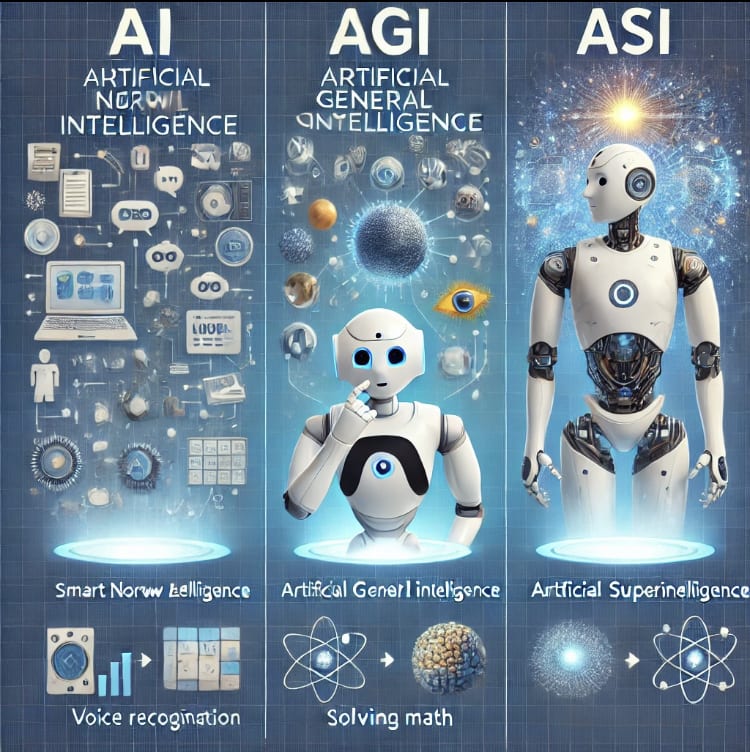
Artificial Intelligence is generally divided into the following three types:
- Artificial Narrow Intelligence (ANI)
- Artificial General Intelligence (AGI)
- Artificial Superintelligence (ASI)
These types show how advanced the system is and how much it can think, learn, and make decisions on its own.
Now let’s explore them in detail.
Artificial Narrow Intelligence (ANI)
Definition of Artificial Narrow Intelligence
Artificial Narrow Intelligence, also known as Weak AI, refers to AI systems designed to perform one specific task. These machines cannot think like humans; they simply follow pre-defined instructions.
They cannot make decisions outside their programming.
Examples of ANI
- Google Search
- Siri, Alexa, Google Assistant
- Chatbots
- Recommendation systems (YouTube, Amazon, Netflix)
- Face recognition apps
- Spam filters
Why ANI Matters
ANI is the most common type of AI used today. It powers almost every digital tool we use daily. Even though it is called “weak”, it performs tasks much faster than humans and improves productivity across industries.
Features of ANI
- Designed for single tasks
- Works through patterns
- High accuracy
- No self-awareness
- Limited decision-making
Artificial General Intelligence (AGI)
Definition of Artificial General Intelligence
Artificial General Intelligence, often called Strong AI, is a system that can understand, learn, and perform any intellectual task that a human can. It will have human-like reasoning, judgment, creativity, and decision-making skills.
AGI is still only a concept; no fully functional AGI system exists yet.
Potential Capabilities of AGI
- Learning from experience
- Solving complex problems
- Understanding emotions
- Making decisions without human help
- Adapting to new situations
- Creating new ideas and strategies
Real-World Possibilities
AGI could transform fields such as:
- Medical diagnosis
- Engineering
- Space exploration
- Education
- Research and development
Many companies like OpenAI, Google, and Meta are researching AGI, but experts believe it may take years before it becomes reality.
Artificial Superintelligence (ASI)
Definition of Artificial Superintelligence
Artificial Superintelligence refers to AI that surpasses human intelligence in every field—creativity, problem solving, scientific reasoning, and emotional understanding. It will be smarter than the entire human population combined.
ASI is also not yet developed, but many scientists debate whether it will benefit or harm society.
Potential Capabilities of ASI
- Inventing new technologies
- Solving diseases
- Predicting natural disasters
- Managing industries automatically
- Making decisions faster than humans
Risks and Concerns of ASI
- Loss of human control
- Ethical concerns
- Job displacement
- Privacy issues
Some researchers argue ASI could become the most important invention in human history, while others warn it could be dangerous if misused.
For more knowledge on advanced AI technologies, you can also check this helpful external resource:
ibm.com/artificial-intelligence
Comparison of ANI vs AGI vs ASI
| Feature | ANI | AGI | ASI |
|---|
| Intelligence Level | Low | Human-like | Beyond human |
| Current Status | Fully active | In development | Hypothetical |
| Abilities | Limited tasks | Multi-tasking | Unlimited potential |
| Examples | Siri, ChatGPT | Not available yet | Not available yet |
Why Understanding AI Types Is Important
Knowing the three types of AI helps businesses, students, and professionals make better decisions. It gives clarity on:
- What AI can currently do
- What future AI may be capable of
- How to prepare for upcoming technologies
- How industries will evolve
As AI evolves, new opportunities for career growth, innovation, and business development will continue to rise.
Internal Link for Further Learning
If you want to explore advanced AI technologies like brain chips, here is a helpful guide on our website:
poweraiengine.com/ai-brain-chip
Final Thoughts
The 3 types of Artificial Intelligence—ANI, AGI, and ASI—represent the entire journey of AI evolution, from simple task-based systems to highly advanced intelligent machines. Today, the world primarily uses ANI, but research is moving fast toward AGI. ASI remains a concept, but it symbolizes the future where machines could surpass human capabilities.
Understanding these three types helps you stay informed, make better decisions, and prepare for the technological future ahead.
If you want more SEO-optimized articles or keywords, just tell me—I’ll write them for you!
Frequently Asked Questions
1. What are the three main types of Artificial Intelligence?
The three main types of Artificial Intelligence are Artificial Narrow Intelligence (ANI), Artificial General Intelligence (AGI), and Artificial Superintelligence (ASI). These categories explain how advanced an AI system is.
2. Which type of AI is used today?
Most AI systems today belong to Artificial Narrow Intelligence (ANI). This includes chatbots, voice assistants, recommendation systems, and image recognition tools.
3. Is AGI (Artificial General Intelligence) real?
Not yet. AGI is a concept and research goal. Scientists and AI companies are working to build AGI, but no machine currently matches human-level intelligence.
4. What is the difference between ANI and AGI?
ANI performs only one specific task, while AGI can perform any intellectual task that a human can, including learning, reasoning, and adapting to new situations.
5. Is Artificial Superintelligence (ASI) dangerous?
ASI has both benefits and risks. It could solve major world problems, but if not controlled properly, it may pose ethical, social, and safety challenges. Safeguards are essential.
6. Which type of AI is used in robots?
Most robots today use ANI, as they perform defined tasks such as assembly, cleaning, scanning, or movement. Future robots may use AGI when advanced systems are developed.
7. Will AI replace human jobs?
AI will automate many tasks, but it will also create new opportunities. Jobs requiring creativity, critical thinking, and emotional understanding will remain in human hands.
8. How can beginners learn AI?
Beginners can learn AI through online courses, YouTube tutorials, blogs, and beginner-friendly platforms. Start with understanding basics like machine learning, neural networks, and data science.