Last Updated on May 30, 2026
Synthetic Intelligence vs Artificial Intelligence: Key Differences Explained
Discover the real difference between Synthetic Intelligence and Artificial Intelligence. Learn how SI works, its future applications, risks, benefits, and why it could reshape modern technology.
Synthetic Intelligence vs Artificial Intelligence: Understanding the Future of Intelligent Systems
Artificial Intelligence (AI) has already transformed the modern digital world. From virtual assistants and recommendation systems to robotics and business automation, AI technologies are now deeply integrated into daily life. However, a newer concept called Synthetic Intelligence (SI) is beginning to attract global attention because of its potential to go beyond traditional AI capabilities.
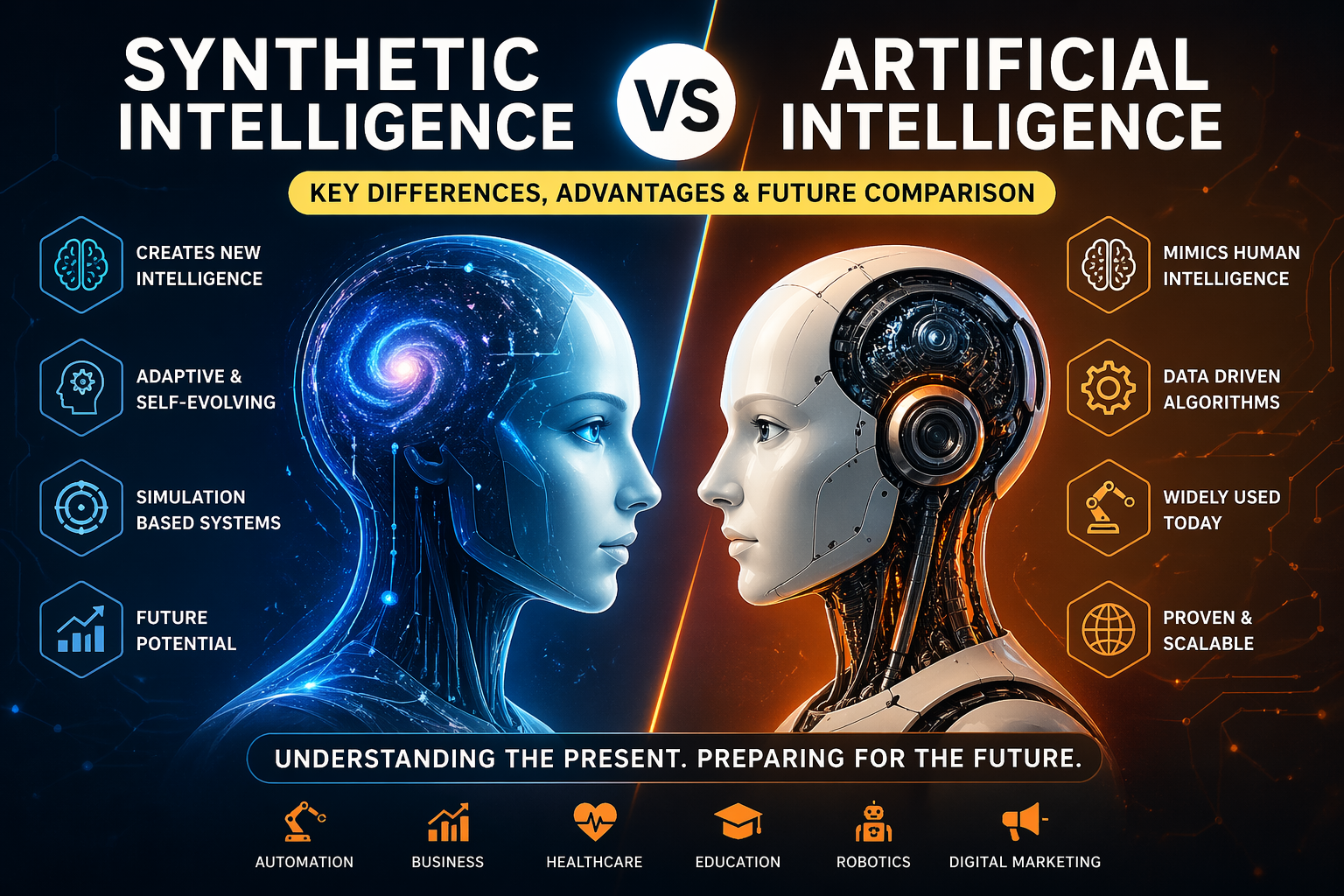
Although many people use the terms Artificial Intelligence and Synthetic Intelligence interchangeably, they are fundamentally different. Artificial Intelligence mainly focuses on simulating human intelligence using trained data models, while Synthetic Intelligence aims to create adaptive systems capable of autonomous reasoning, continuous learning, and independent decision-making.
As intelligent technologies continue evolving rapidly in 2026, businesses, developers, and researchers are increasingly exploring how synthetic intelligence could shape the future of automation, robotics, cybersecurity, healthcare, and digital transformation.
In this article, you’ll learn:
The future of intelligent technologies
What Artificial Intelligence really means
What Synthetic Intelligence is
How intelligent systems evolved over time
Key differences between AI and SI
Human intelligence vs machine intelligence
Real-world applications of synthetic intelligence
Risks and ethical concerns
Why synthetic intelligence matters in 2026
What Is Artificial Intelligence (AI)?
Artificial Intelligence refers to computer systems designed to simulate human intelligence. AI systems can analyze data, recognize patterns, automate tasks, solve problems, and make decisions using algorithms and machine learning models.
Today, AI is used across almost every industry. Search engines, voice assistants, recommendation systems, fraud detection tools, autonomous vehicles, and chatbots all rely on AI technologies.
Businesses are also increasingly adopting advanced AI-driven ERP systems to improve workflow automation, productivity, and operational efficiency.
Main Characteristics of Artificial Intelligence
- Learns from historical data
- Automates repetitive tasks
- Uses machine learning algorithms
- Improves speed and efficiency
- Works within predefined objectives
- Requires human-created training models
Common Examples of AI
- Siri and Alexa
- AI customer support chatbots
- Netflix recommendation systems
- AI-powered healthcare diagnostics
- Self-driving vehicles
- Smart security systems
According to IBM Artificial Intelligence Research, AI systems are designed to simulate human learning, reasoning, and decision-making processes.
Despite its advanced capabilities, traditional AI still depends heavily on human training, structured datasets, and predefined instructions.
What is Synthetic Intelligence?
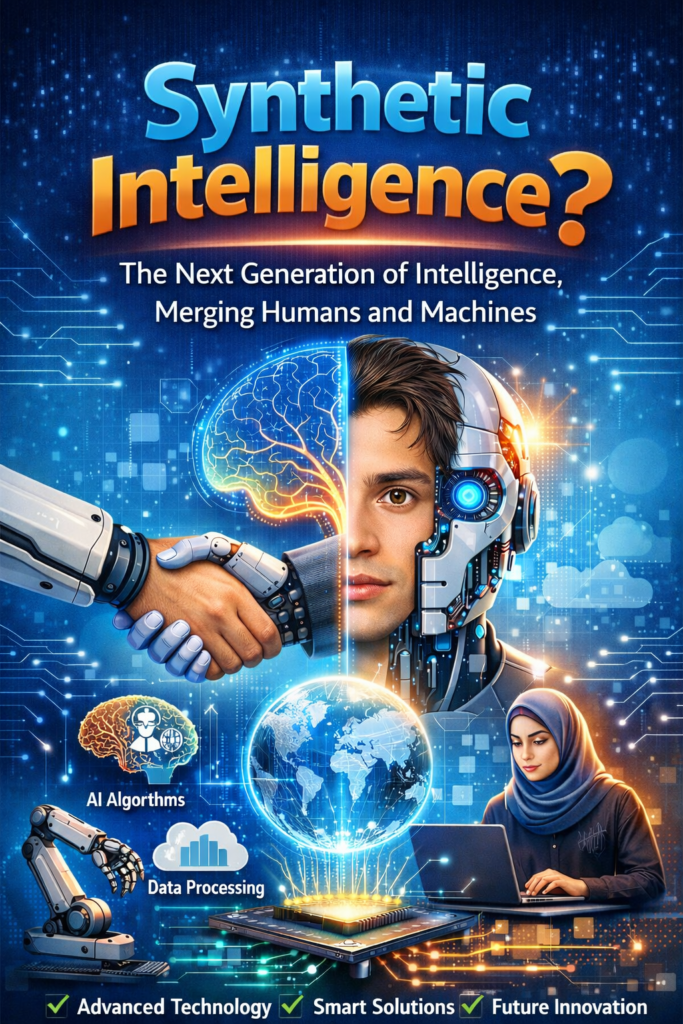
Synthetic Intelligence is considered the next evolution of intelligent systems. Instead of simply mimicking human intelligence, SI focuses on creating systems capable of adaptive reasoning, autonomous learning, contextual understanding, and continuous self-improvement.
In simple terms:
Artificial Intelligence imitates human thinking, while Synthetic Intelligence attempts to create an entirely new form of adaptive intelligence.
Synthetic intelligence combines multiple advanced technologies, including:
- Artificial Intelligence
- Cognitive computing
- Neural learning systems
- Autonomous reasoning
- Context-aware decision-making
- Self-evolving algorithms
Unlike traditional AI systems that often require retraining with new datasets, synthetic intelligence aims to learn continuously through real-world interaction and evolving environments.
Evolution From Artificial Intelligence to Synthetic Intelligence
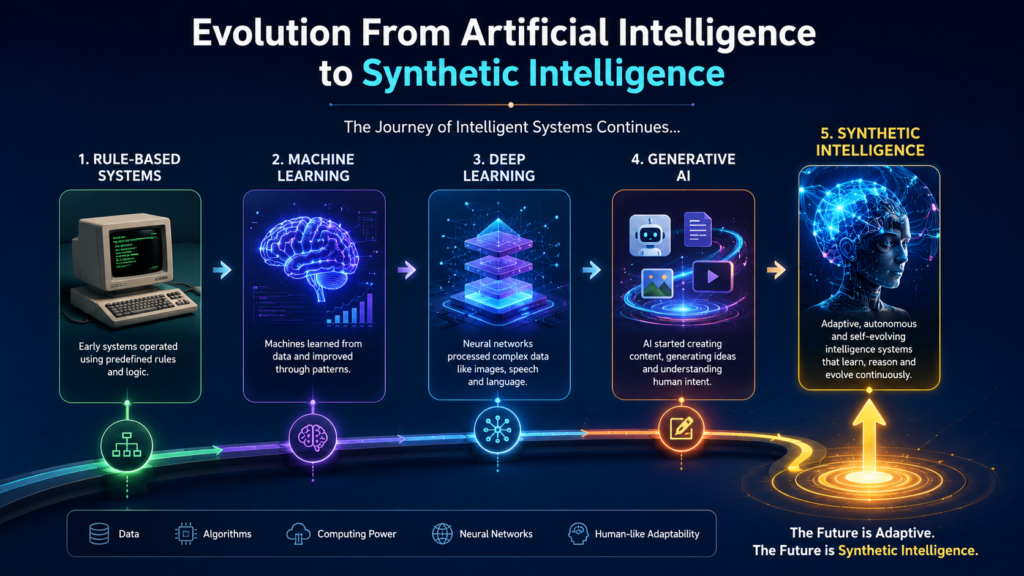
The journey toward synthetic intelligence did not happen overnight. Intelligent technologies have evolved through multiple stages over the years.
Rule-Based Systems
Early AI systems operated using predefined rules. These systems could only perform simple tasks based on programmed instructions.
Machine Learning
Machine learning allowed systems to analyze large datasets and improve performance through pattern recognition.
Many modern business tools now depend heavily on machine learning in business analytics for forecasting and decision-making.
Deep Learning
Deep learning introduced advanced neural networks capable of processing complex data such as images, speech, and language.
Generative AI
Generative AI systems can now create text, images, code, videos, and digital content.
Businesses worldwide are rapidly adopting Generative AI technologies to improve marketing, automation, and customer engagement.
Synthetic Intelligence
Synthetic intelligence represents the next possible stage of intelligent evolution, where systems may continuously learn, adapt, reason, and evolve with minimal human intervention.
Synthetic Intelligence vs Artificial Intelligence
Although both technologies involve intelligent systems, their capabilities and long-term goals are significantly different.
| Feature | Artificial Intelligence (AI) | Synthetic Intelligence (SI) |
|---|---|---|
| Purpose | Mimics human intelligence | Creates adaptive intelligence |
| Learning Method | Data-trained models | Continuous self-learning |
| Flexibility | Task-specific | Multi-domain adaptability |
| Human Dependency | High | Lower over time |
| Decision-Making | Pattern-based | Context-aware reasoning |
| Evolution | Requires retraining | Self-improving systems |
| Creativity | Simulated creativity | Independent idea generation |
| Intelligence Scope | Narrow or general AI | Advanced autonomous cognition |
Human Intelligence vs Synthetic Intelligence
One of the biggest debates in technology is whether intelligent systems could eventually rival human thinking.
Human Intelligence Strengths
Humans naturally possess:
Intuition
Emotional understanding
Creativity
Ethical judgment
Social awareness
Complex reasoning
Synthetic Intelligence Strengths
Synthetic intelligence may eventually outperform humans in:
- Data processing speed
- Pattern recognition
- Predictive analysis
- Continuous learning
- Multi-task automation
- Real-time optimization
However, SI still lacks genuine human consciousness, emotional depth, and moral understanding.
Why Synthetic Intelligence Matters in 2026
Interest in synthetic intelligence is rapidly increasing because modern AI technologies are evolving faster than ever before.
Several trends are driving this discussion:
- Growth of autonomous AI systems
- Rapid robotics advancement
- Increasing AI regulation worldwide
- Expansion of intelligent automation
- Rise of adaptive machine learning
- Development of human-like AI assistants
As businesses compete to adopt smarter technologies, synthetic intelligence is becoming one of the most discussed future concepts in the tech industry.
Why Synthetic Intelligence Is Becoming a Major Technology Trend in 2026
The discussion around synthetic intelligence is growing rapidly in 2026 as businesses and researchers search for more adaptive and autonomous intelligent systems. Unlike traditional AI models that rely heavily on predefined training data, synthetic intelligence focuses on continuous learning, contextual understanding, and self-improving decision-making.
The rise of generative AI, robotics, and intelligent automation has accelerated interest in next-generation intelligent systems capable of evolving in real time. Many experts believe synthetic intelligence could eventually improve industries such as healthcare, cybersecurity, finance, and education by creating more flexible and responsive technologies.
As organizations continue investing in advanced automation, synthetic intelligence is becoming one of the most talked-about future innovations in the tech industry.
Why Synthetic Intelligence Could Be More Advanced Than AI
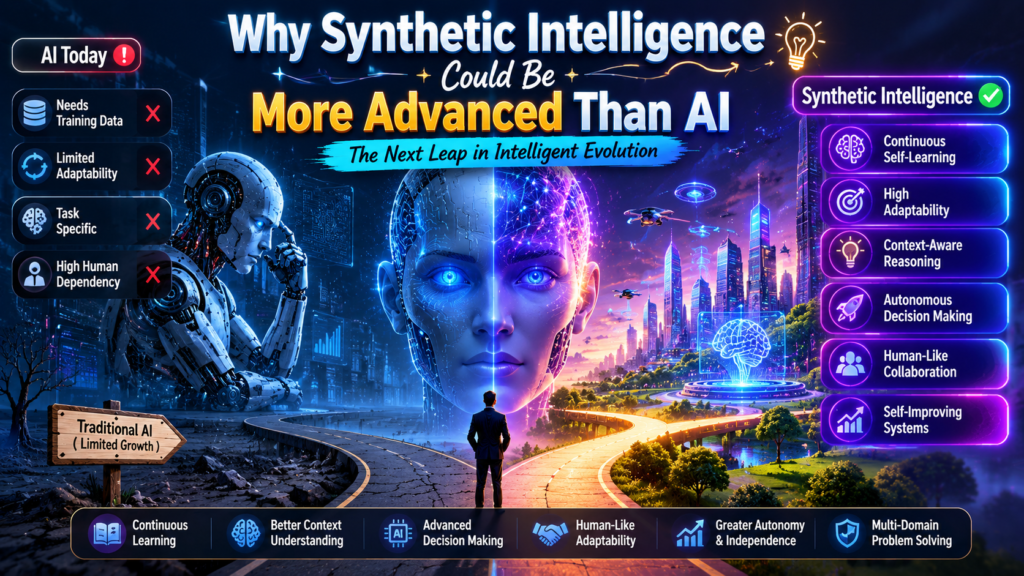
Researchers believe synthetic intelligence may overcome many limitations of traditional AI systems.
1. Continuous Autonomous Learning
Traditional AI models often stop learning after deployment unless developers retrain them using updated data.
Synthetic intelligence could continuously evolve using:
- Real-time experiences
- Environmental interaction
- Dynamic adaptation
- Behavioral learning
This could make intelligent systems significantly more flexible and responsive.
2. Better Context Understanding
AI systems often struggle with emotional understanding and changing situations.
Synthetic intelligence aims to improve:
- Human interaction
- Situational awareness
- Contextual reasoning
- Adaptive communication
This could create more natural interactions between humans and intelligent systems.
3. Advanced Decision-Making
Unlike traditional AI models that follow predefined objectives, synthetic intelligence may generate independent solutions based on changing circumstances.
This could revolutionize industries such as:
- Healthcare
- Robotics
- Finance
- Cybersecurity
- Smart cities
- Education
4. Human-Like Adaptability
Synthetic intelligence systems may eventually adapt similarly to humans by learning from mistakes, experiences, and environmental feedback.
This level of adaptability is one of the biggest differences between AI and SI.
Real-World Applications of Synthetic Intelligence
Although SI is still evolving, many industries are already moving toward synthetic intelligence-inspired technologies.
Healthcare
Synthetic intelligence may help healthcare providers:
- Detect diseases earlier
- Create personalized treatment plans
- Monitor patient behavior
- Improve robotic surgeries
Robotics
Future robots may use synthetic intelligence to adapt naturally to changing environments without requiring constant programming updates.
Applications include:
- Industrial robotics
- Elderly care robots
- Space exploration
- Disaster-response machines
The future of robotics is closely connected with intelligent automation systems and evolving AI technologies.
You can also explore the future of synthetic intelligence automation in robotics.
Finance
Financial institutions may use SI for:
- Real-time fraud detection
- Risk management
- Predictive investment analysis
- Autonomous trading systems
Cybersecurity
Synthetic intelligence could identify cyber threats before attacks happen by continuously learning from evolving threat patterns.
Education
SI-powered educational systems may eventually provide:
- Personalized learning experiences
- Adaptive teaching methods
- Intelligent tutoring assistants
- Student behavior analysis
Potential Risks of Synthetic Intelligence
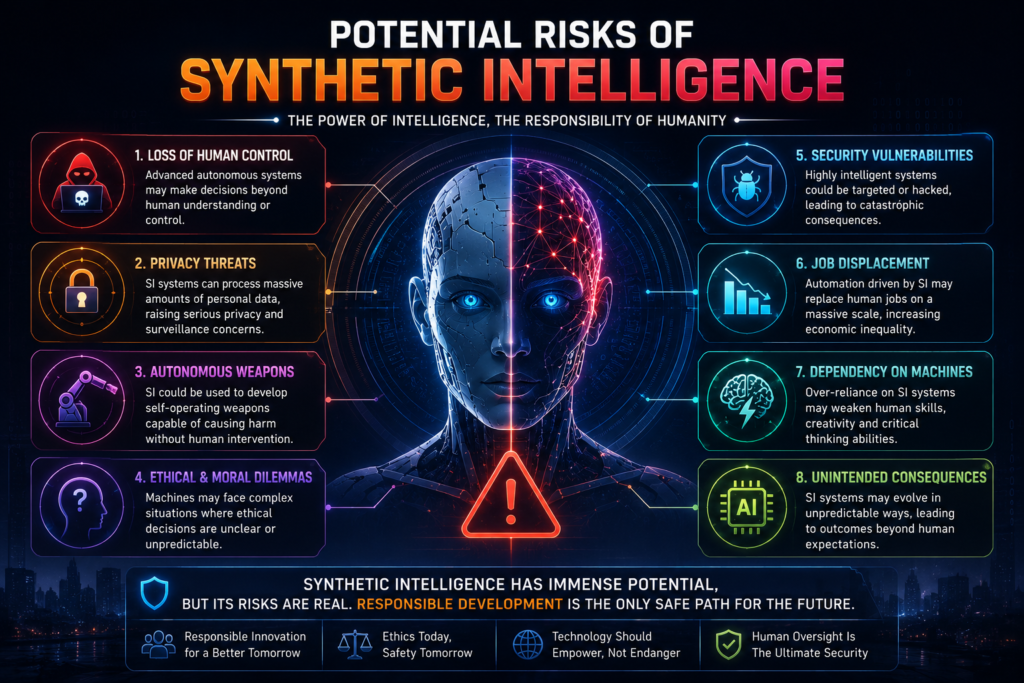
While synthetic intelligence offers exciting possibilities, it also introduces serious concerns.
Ethical Concerns
Advanced intelligent systems raise important ethical questions related to:
- Privacy
- Transparency
- Bias
- Accountability
- Human control
AI Dependency
Overreliance on intelligent systems could reduce human decision-making skills over time.
Autonomous Weapons
Some experts fear synthetic intelligence could eventually contribute to autonomous military systems without sufficient human oversight.
Cybersecurity Threats
Highly autonomous systems may become attractive targets for hackers if proper safeguards are not implemented.
Loss of Human Control
One of the biggest concerns surrounding advanced intelligent systems is whether humans will always maintain control over autonomous technologies.
Will Synthetic Intelligence Replace Artificial Intelligence?
Synthetic intelligence is unlikely to replace AI completely anytime soon. Instead, SI will probably evolve from existing AI technologies.
Traditional AI will continue handling:
- Automation
- Predictive analytics
- Customer support
- Data processing
- Operational optimization
Meanwhile, synthetic intelligence may focus on:
- Adaptive reasoning
- Autonomous learning
- Human-like collaboration
- Context-aware decision-making
Both technologies will likely work together rather than compete directly.
Key Takeaways
- Artificial Intelligence mimics human intelligence using trained models.
- Synthetic Intelligence focuses on adaptive autonomous learning.
- SI could become more flexible and context-aware than traditional AI.
- Healthcare, robotics, finance, and cybersecurity may benefit significantly.
- Ethical AI development and human oversight remain essential.
- Synthetic intelligence is becoming a major topic in future technology discussions.
The Future of Synthetic Intelligence
The future of synthetic intelligence looks extremely promising as neural computing, machine learning, and cognitive technologies continue advancing rapidly.
Experts believe SI could contribute to:
- Smarter healthcare systems
- Advanced robotics
- Intelligent cybersecurity
- Autonomous transportation
- Human-machine collaboration
- Next-generation business automation
As technology evolves, businesses that adopt intelligent systems early may gain major competitive advantages in the digital economy.
Final Thoughts
Artificial Intelligence has already transformed the modern world, but Synthetic Intelligence could represent the next major leap in intelligent technology.
While AI focuses on simulating human thinking, synthetic intelligence aims to create adaptive systems capable of autonomous learning, reasoning, and evolution.
Although SI is still developing, its future impact on healthcare, robotics, cybersecurity, education, and business automation could reshape the future of technology itself.
Understanding the difference between synthetic intelligence and artificial intelligence is becoming increasingly important as businesses and industries move toward more advanced intelligent systems.
The future may not be about humans competing with machines — but humans and intelligent systems working together to solve complex global challenges.
FAQs
Why is synthetic intelligence important for future technology?
Synthetic intelligence could help create more adaptive, context-aware, and autonomous systems capable of improving decision-making, automation, robotics, and intelligent human-machine collaboration in the future.
Can synthetic intelligence become self-aware?
Currently, synthetic intelligence is not self-aware. However, future advancements may increase system autonomy and adaptive reasoning capabilities.
How is synthetic intelligence used in robotics?
Synthetic intelligence may help robots adapt naturally to changing environments, improve decision-making, and learn from real-world experiences.
What are the risks of autonomous intelligence systems?
Potential risks include privacy concerns, cybersecurity threats, ethical issues, misinformation, and excessive dependence on intelligent technologies.
Will businesses adopt synthetic intelligence in the future?
Yes, many industries are expected to adopt advanced intelligent systems to improve automation, decision-making, and operational efficiency.