Artificial General Intelligence (AGI): Meaning, Examples, Future & Risks
Learn what Artificial General Intelligence (AGI) is, how it works, examples, benefits, risks, and future impact. A complete beginner-to-advanced guide.
What Is Artificial General Intelligence (AGI)?
Artificial General Intelligence (AGI) refers to a type of AI that can think, learn, and solve problems like a human across multiple domains.
Unlike basic AI systems, AGI is not limited to a single task. It can:
- Understand context
- Learn new skills without training
- Make decisions like humans
For a deeper beginner-friendly explanation, read:
What is AGI
Types of Artificial Intelligence (Where AGI Fits)
AI is divided into different levels:
- Narrow AI (Weak AI)
- Artificial General Intelligence (AGI)
- Superintelligence (ASI)
Learn all AI types in detail here:
Types of Artificial Intelligence with Examples
How Does Artificial General Intelligence Work?
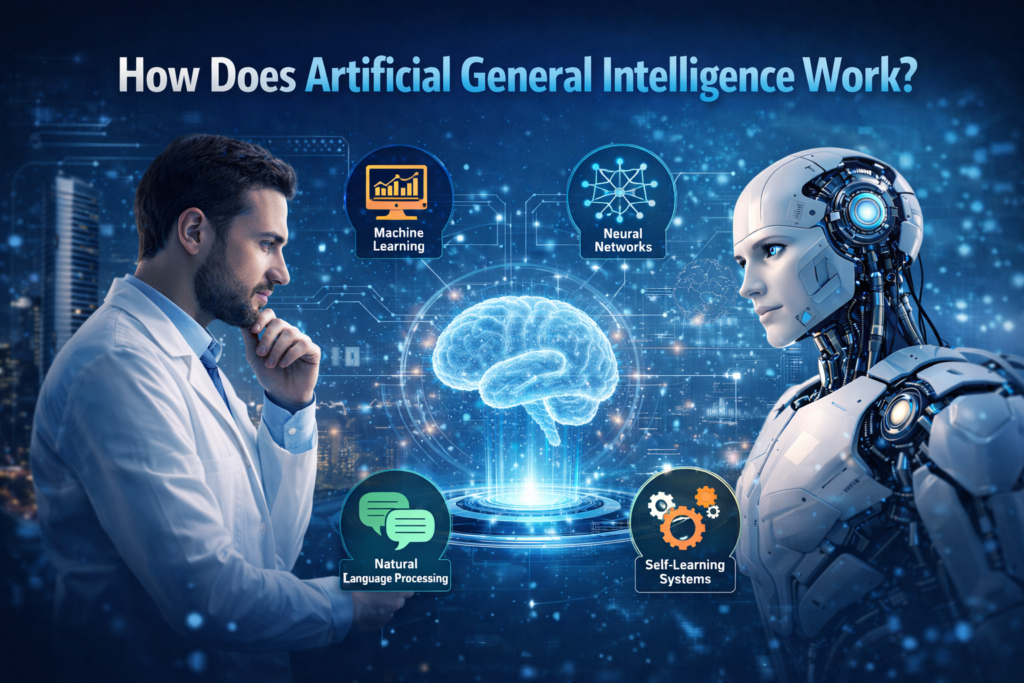
AGI works using a combination of advanced technologies:
Machine Learning
Helps systems learn from data and improve automatically.
Neural Networks
Inspired by the human brain to process complex patterns.
Natural Language Processing (NLP)
Allows AGI to understand and communicate like humans.
Self-Learning Systems
AGI can improve itself without human intervention.
Real-Life Examples of Artificial General Intelligence
Currently, true AGI does not fully exist, but some systems are close:
- Advanced AI chatbots
- Robotics with learning abilities
- Autonomous systems
Learn more about AGI in robotics:
AGI Robot Meaning
Artificial General Intelligence vs Artificial Intelligence
| Feature | AI (Narrow AI) | AGI |
|---|---|---|
| Capability | Single task | Multiple tasks |
| Learning | Limited | Human-like |
| Flexibility | Low | High |
| Intelligence | Task-based | General intelligence |
Read detailed comparison:
Artificial General Intelligence Explained
Benefits of Artificial General Intelligence
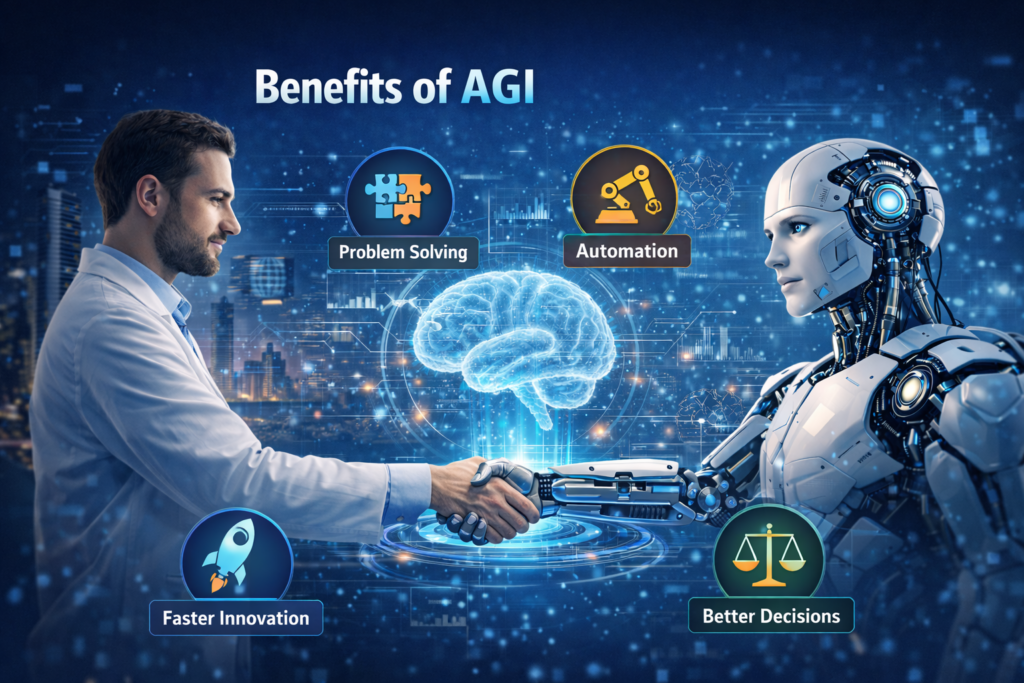
1. Human-Level Problem Solving
AGI can solve complex global issues.
2. Automation at Scale
Reduce human workload in industries.
3. Faster Innovation
Accelerates scientific discoveries.
4. Better Decision Making
Data-driven and unbiased decisions.
Risks of Artificial General Intelligence
1. Job Displacement
Many jobs may become automated.
2. Ethical Concerns
Control and misuse of AGI.
3. Security Risks
Potential misuse in cyber attacks.
4. Loss of Human Control
AGI could act beyond human understanding.
Future of Artificial General Intelligence
Experts believe AGI could emerge in the next few decades.
Key predictions:
- AGI will transform industries
- Humans + AI collaboration will increase
- Ethical AI regulations will grow
According to IBM AI Research, AGI aims to replicate full human cognitive abilities and remains one of the biggest goals in AI development.
Impact of AGI on Jobs and Business
AGI will:
- Replace repetitive jobs
- Create new tech opportunities
- Transform healthcare, finance, and education
Businesses using AGI will gain a huge competitive advantage.
FAQ: Artificial General Intelligence
What is Artificial General Intelligence in simple words?
AGI is AI that can think and learn like a human across any task.
Is AGI available today?
No, true AGI does not exist yet, but research is ongoing.
Will AGI replace humans?
It may replace some jobs but will also create new opportunities.
Why is AGI important?
It can solve complex global challenges and improve human life.
Conclusion
Artificial General Intelligence (AGI) represents the future of AI — a system capable of human-like thinking and learning.
While it offers massive benefits like automation and innovation, it also brings serious risks that must be managed carefully.
To fully understand AGI, explore these guides: